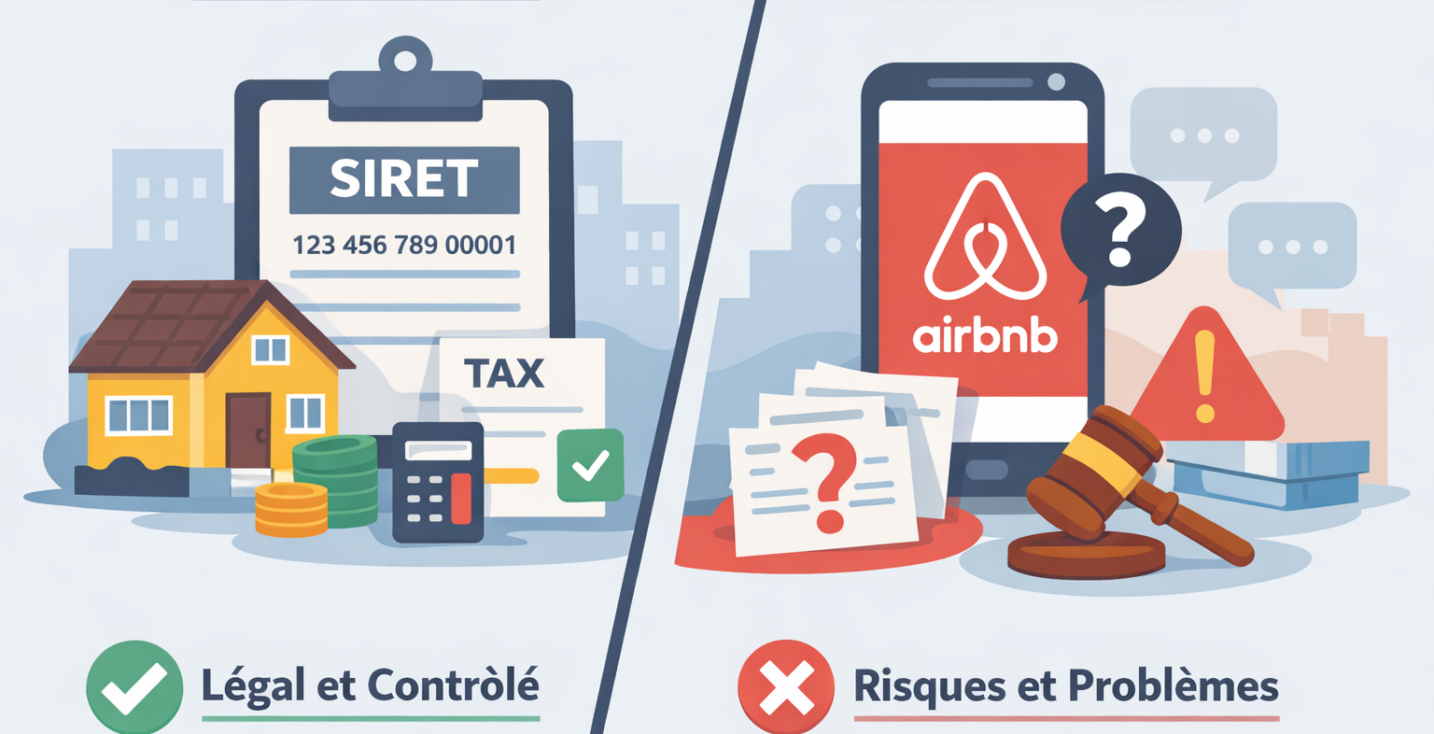
Why legally register your LMNP business (SIREN/SIRET) instead of “letting Airbnb manage it”?

We often hear: «I rent on Airbnb, they collect the tourist tax, they send me a recap... so that's enough.’
In practice, Airbnb (and other platforms) can manage a part of the traveller experience, but not the legal existence of your furnished rental activity in France.

And above all: registering LMNP (Guichet unique → SIRET/SIREN) is not just a formality “for the administration”. It's also what gives you the hand, It protects you and saves you from a number of nasty surprises.


LMNP: it's not a “status”, it's a declarable activity

LMNP describes a furnished rental activity carried out on a non-professional basis. Since 1 January 2023, LMNP activity has required a online registration via the formalities desk and obtaining a SIRET number (in 15 days from the start of the rental period).

In practical terms: even if you only rent on Airbnb, registration doesn't just happen“.


What Airbnb does... and what Airbnb will never do for you

Airbnb can

  • provide you with documents and summaries,
  • apply certain platform-related rules,
  • and, above all, to collect/transmit tax information under DAC7 (EU).

Airbnb cannot (and must not)

  • declare the start of your LMNP business,
  • choose your tax system (micro-BIC vs réel),
  • managing your off-platform tax obligations“ (e.g. CFE, consistency of declarations),
  • or secure your business if you also rent via Booking/Abritel/direct.

On impots.gouv.fr, the authorities are very clear: registration is used in particular to obtain a SIRET, publicise the existence of the business, and indicate the tax regime chosen.


The real advantages of having a SIREN/SIRET (and of doing it early)

1) You're square (and you sleep better)

The number one benefit is peace of mind: you declare your activity, you obtain your identifiers, and you take the steps required by the authorities (including the 15-day deadline).

2) You regain control over your tax situation (and often your profitability)

The “sinews of war” in LMNP is the tax choice and its implementation (micro-BIC vs réel, charges, depreciation, etc.).
Without your own registration, you are more likely to :

  • choose the wrong frame,
  • choose it too late,
  • or find yourself having to “catch up” on items when you file your tax return.

And this rarely has a neutral effect on the result.

3) You put your case on a professional footing (bank, accountant, insurance companies, partners)

A SIRET is a simple “marker”: your business exists, it is identified, and your file becomes much easier to read when a third party asks you for information (accountant, bank, service provider, etc.).

4) You are no longer dependent on a platform

Today Airbnb, tomorrow :

  • Booking,
  • Abritel,
  • your site,
  • or direct bookings.

Your SIRET does not change your marketing strategy.

5) You are consistent with the reality of 2023+: platform transparency is increasing (DAC7)

DAC7 requires Airbnb to collect and transmit tax information on hosts receiving income via the platform. To put it plainly: “I'm not doing anything” makes less and less sense.


The (very real) disadvantages of not doing so

1) You put off doing something you have to do... and you often end up doing it in a hurry

The most common situation is that you wait until “later” and then have to regularise the situation at the wrong time (tax return, change of platform, request for supporting documents, etc.). But the obligation + the 15-day deadline exist.

2) You potentially lose money (wrong tax choice, wrong implementation)

The No. 1 risk is not the immediate fine: it's the loss of earnings (incorrect engine speed, non-optimised loads, framing errors).

3) You are exposing yourself to tax inconsistencies (CFE, returns, supporting documents)

Furnished lettings come with a number of obligations, including CFE (with exemptions in certain cases, notably where receipts are ≤ €5,000).
Airbnb doesn't manage this “for you”, and the day it drops, it becomes your subject.

4) Your “strategy” is based on a belief: “Airbnb = compliance”.”

Airbnb can do useful things, but the tax authorities point out that obtaining a SIRET and declaring that they are starting up their business.


OK... and how do we do it?

For the practical part (the right choices to tick on the Guichet unique INPI, step by step), we have detailed everything here:

👉 Setting up your LMNP business on the Guichet unique (INPI): which options to choose, step by step


Conclusion

Registering as an LMNP is not about “pleasing the authorities”. It's about :

  • comply,
  • secure your income,
  • keep control of your tax affairs,
  • and not be dependent on a platform whose rules may change.
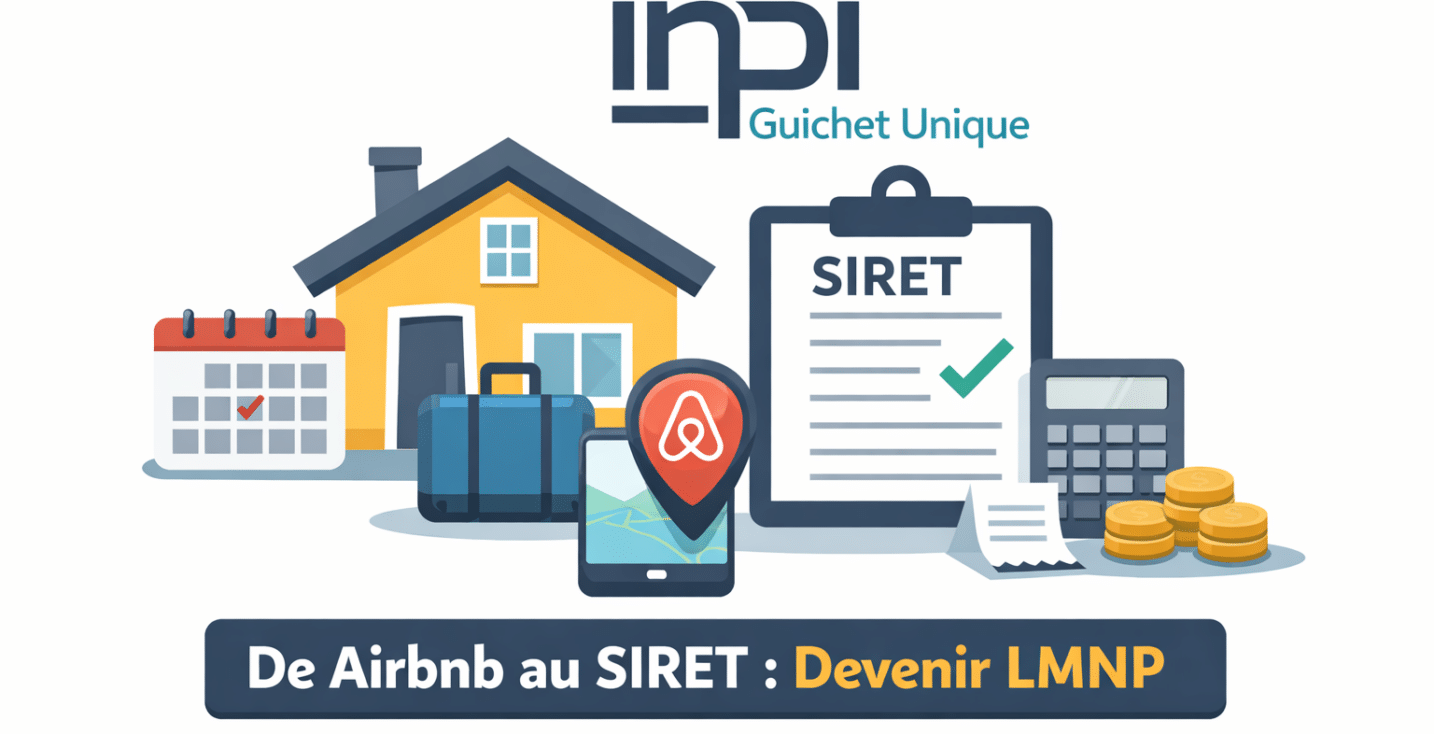
Setting up your LMNP business on the Guichet unique (INPI): which options to choose, step by step

You wish to register a non-professional furnished rental (LMNP) to obtain a SIRET and be “in order” fiscally? Since the introduction of the One-stop shop, If you want to register your company, you can do so online via INPI (business formalities). The trickiest part isn't the paperwork... it's getting the right information. tick the right options to avoid mistakes (such as confusing “micro-entrepreneur” with “micro-BIC”).

Here's a simple, practical, no-nonsense guide.

When you start out in furnished rental, you often hear: “Airbnb takes care of everything”.”. In reality, Airbnb can manage a part (e.g. tourist tax on bookings made with them), but not what comes under your registration and your tax obligations.

✅ INPI (Guichet unique) link ready to click


1) SIREN vs SIRET: what is it and why do you need it for LMNP?

  • SIREN the number that identifies your legal unit“ (you, as a declared activity). Issued by INSEE via the Guichet unique.
  • SIRET the number that identifies an establishment (often the address of the rented property / the activity attached to a location).

📌 So, when you “create your LMNP” on the Guichet unique, you don't choose a “magic status”: you register your business and the administration will assign you your login details.


2) “Airbnb can do anything”: what it covers... and what it doesn't cover

What Airbnb can do (in certain cases)

  • Tourist tax Airbnb states that it collects and remits tourist tax for bookings made on its platform (in accordance with the applicable local rules).
  • Transmission of tax information (DAC7) Airbnb collects and transmits certain tax information to the authorities in the EU, and provides you with an annual summary.

What Airbnb doesn't do for you

A) Registering (SIRET/SIREN)

In France, the obligation to obtain a SIRET applies to hirers, including non-professional, by registering online at the formalities desk.
➡️ Put another way: even if you only rent via Airbnb, registration remains your responsibility.

B) Choosing and securing your tax regime (micro-BIC / real)

The tax authorities point out that this procedure is used in particular to :

  • obtain a SIRET,
  • publicise the existence of the business,
  • indicate the tax regime chosen.
    And the LMNP income tax return remains to be included in your declaration (micro-BIC or real).

C) Managing your business taxes (e.g. CFE)

La CFE may apply to furnished lettings under certain conditions (in particular a revenue threshold in some cases).
➡️ Airbnb will not pay the CFE on your behalf, will not declare it, and will not manage any exemptions you may have: that's your tax system.

D) Covering you if you rent elsewhere than on Airbnb

As soon as you take :

  • a reservation live (website, word of mouth),
  • another platform (Booking, Abritel, etc.),
    Airbnb no longer “centralises” anything. Your SIRET remains the single administrative base for your business.

3) In plain English: why it's a good idea to do it now

  1. This is an obligation (LMNP registration via Guichet unique).
  2. That brings your situation into line (declared activity + tax regime).
  3. That way you won't think “tourist tax = all sorted” (spoiler: no).
  4. With DAC7, the platforms transmit information It's best if your business is straightforward and consistent.

Mini-recall (the trap to avoid)

When Guichet unique asks you if you want to be micro-entrepreneur for a “classic” LMNP, answer NO.
Le micro-BIC is a tax system, not micro-entrepreneur status.

Concierge fees: when, how and why should they be deducted from tax?

Do you pay for concierge services (cleaning, check-in/out, traveller management)? Here's when and how to deduct your CLM concierge fees, depending on your tax regime (micro or actual) for furnished or unfurnished accommodation.

You entrust your property to CLM Conciergerie (or another...) to save time, improve the passenger experience and make your operations more secure. The good news is: in many cases, caretaker costs are tax-deductible... as long as you have the right tax regime and keep the right supporting documents.

This article explains why, when and how deduct your caretaker costs (management, cleaning, linen, consumables, etc.), with simple, up-to-date benchmarks.

⚠️ Useful note: this article is for information only and does not replace the advice of a chartered accountant or the tax authorities.

1) Why deduct concierge fees?

Deducting a charge means reduce your taxable income, so often pay less tax and social security contributions (depending on your situation).

In short-term rental, caretaker costs can quickly become a major expense:

  • travel management and communication,
  • check-in / check-out,
  • cleaning, laundry / linen,
  • small supplies (reception, consumables),
  • coordination of work, light maintenance.

If you are at actual regime, These expenses are deducted from the taxable income (and may, depending on the circumstances, contribute to a very low or even zero taxable income, thanks to all the expenses and depreciation for furnished accommodation). The general principle on the real BIC side is as follows deduction of expenses and management costs related to the operation.


2) The key point: your tax regime (micro vs real)

It is the diet which determines whether you can deduct your CLM expenses “to the penny”.

A) You are under the “micro” scheme: no actual deduction

  • Visit micro-BIC (furnished rental), the administration applies a lump-sum allowance and you don't deduct your expenses one by one. It's there in black and white on Service-Public.
  • Visit micro-foncier (bare rental), same logic: flat-rate allowance and no deduction of actual expenses.

✅ Conclusion : at the microphone, your caretaker costs are “covered” by the allowance... but you do not deduct them specifically.

B) You are on a “real” tax regime: yes, concierge fees become deductible

  • Visit Furnished property (BIC réel) You deduct operating expenses (including management costs) in accordance with BIC rules.
  • Visit actual bare-rental (income from property) management/administration costs relating to the property are deductible under the actual scheme.

✅ Conclusion : real, CLM costs (management, cleaning, linen, etc.) are in principle deductible if they are incurred for the rental activity and justified.


3) When is the deduction most attractive?

In practice, the deduction of caretaker expenses is particularly attractive if :

1) You have a lot of charges

If your expenses (caretaking + cleaning + linen + loan interest + insurance + property tax + condominium tax + etc.) exceed the micro deduction, the real is often more favourable.

2) You are renting out unclassified tourist accommodation

Since the recent changes, the taxation of tourist rentals has changed: for a unclassified furnished tourist accommodation, the micro can apply a allowance of 30% (instead of a higher allowance previously), which makes the real more attractive for many homeowners.

Remember: the more your concierge service costs (and your overall costs), the more the actual regime becomes relevant.


4) How do you actually deduct your CLM concierge fees?

Step 1 - Identify your type of rental

  • Furnished rental (short-term, Airbnb/Booking/Abritel, etc.) → category BIC (micro-BIC or real)
  • Bare rental → category land incomes (micro-foncier or réel)

Service-Public clearly explains the “furnished = BIC / unfurnished = land” logic.

Step 2 - Register (or switch) to the actual regime if you want to deduct by the penny

This is condition no. 1: CLM costs are deducted from expenses on an actual basis.

Step 3 - Keep the right supporting documents

To secure your deduction :

  • CLM invoices (or detailed statements),
  • proof of payment (bank transfers, direct debits, etc.),
  • details if possible: management / cleaning / laundry / interventions,
  • supplier invoices if you have them directly,
  • platform commission statements (Airbnb/Booking, etc.) if relevant to the actual situation.

Tip: if CLM deducts certain amounts directly from your payments, it's not a problem the important thing is to have clear justification (invoice / statement) and a traceability.

Step 4 - Deduce “the right thing”.”

A few simple guidelines:

  • What you actually pay to CLM = actual deductible expense (if linked to the operation).
  • What is billed to the passenger Depending on the set-up, this may be an “income + expense” flow. The important thing is to be coherent and justified (your accountant will give you a clear picture).

5) What CLM costs are generally involved?

Depending on your contract and the way you operate, you will often find :

  • Management/concierge fees (management, passenger relations, coordination)
  • Cleaning (services between stays)
  • Linen / laundry (purchase, hire, dry cleaning, maintenance)
  • Reception consumables (if billed to the owner)
  • Minor repairs / light maintenance (if invoiced)

The idea: expenditure must be undertaken in the interests of the rental business and correctly justified.


6) Quick FAQ (the questions we get asked all the time)

“I'm on micro-BIC: can I still deduct CLM?”

No: micro-BIC, the allowance replaces the deduction of your expenses.

“I rent unfurnished: is it the same?”

Micro-foncier status, no actual deductible expenses ; under the actual scheme, management costs relating to the property may be deductible.

“At what point is it worth going real?”

This is often the case when your annual expenses (including caretaking) become significant, rather than the micro allowance, or as soon as you are “forced” to do so by the thresholds/rules applicable to your type of letting. The parameters for furnished tourist accommodation have changed recently, so it's best to carry out a simulation.


Conclusion

  • Micro = simple, but no detailed deduction.
  • Real = more follow-up, but (often) very advantageous deduction for homeowners who pay a caretaker and have high charges.

If you are a CLM homeowner, we can help you to structure your supporting documents (invoices/statements) so that your accountant has a clean file and you can optimise your tax situation in full compliance.

Need a quick update on your case (micro vs real)? Contact us, We'll show you what you'll need to gather for a simulation.

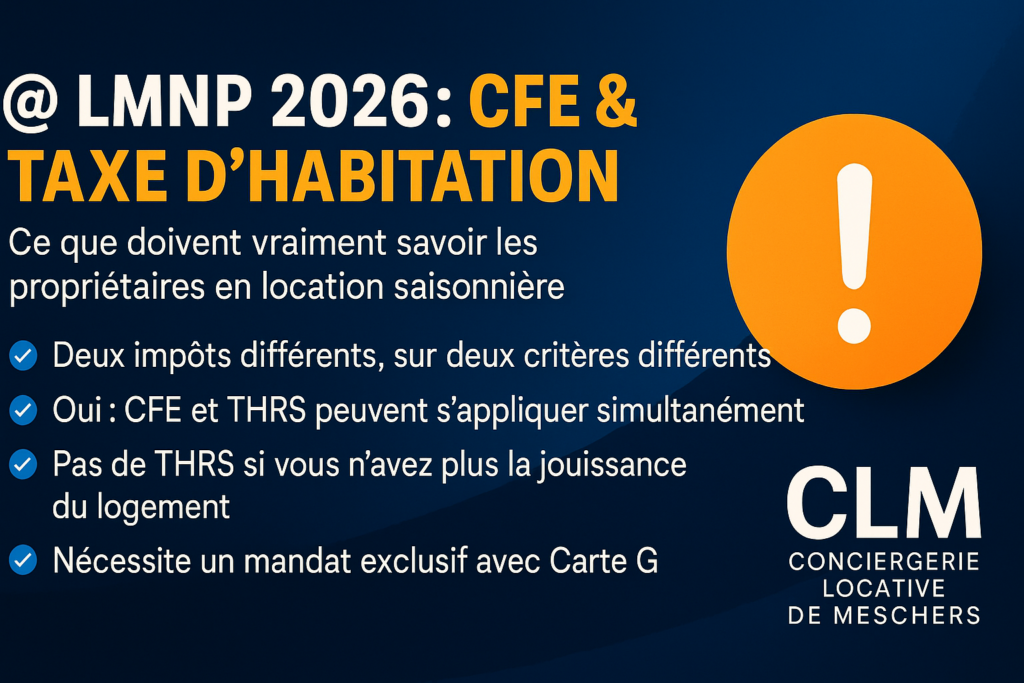
LMNP 2026: CFE & Council Tax (THRS)

What holiday rental owners really need to know

With recent tax changes, many homeowners are wondering whether they should pay :

  • the CFE (Cotisation Foncière des Entreprises),
  • the Council tax on second homes (THRS),
  • or sometimes both.

Online discussions often add to the confusion. So here is a clear, up-to-date version, based on the ministerial responses of 3 June 2025 and current tax doctrine.


1️⃣ CFE and THRS: two different taxes for two different purposes

✔ CFE

The CFE concerns furnished lettings.
It is payable by anyone operating a furnished property, including those operating a LMNP scheme.

There are, however, some possible exemptions:

  • rental income < 5,000 per year,
  • 1st year in business,
  • exemptions decided by the municipality,
  • specific zones (FRR).

✔ THRS (Council tax on second homes)

THRS applies if the owner retains the right of use on 1 January.

That's the crux of the matter:
👉 It's not the number of days rented that counts,
👉 But the possibility of using the accommodation, even rarely.

If you are free to dispose of it, even theoretically, THRS is due.


2️⃣ Yes: CFE and THRS can be applied simultaneously

This is even the situation the most common as a seasonal LMNP.

The two taxes are not linked:

  • CFE taxes the activity,
  • THRS taxes the use of the property.

3️⃣ Can I avoid paying council tax (THRS)?

Yes, in just one case:
👉 if the owner does not retain the use of the property at all.

And this can only be the case :

✔ If the dwelling is entrusted in EXCLUSIVE MANAGEMENT MANDATE

to a professional holder of the G (Hoguet law).

This is the only situation recognised by the tax authorities in which :

  • the owner can no longer use the property,
  • personal use is contractually impossible,
  • enjoyment is transferred to the property manager.

👉 So :

Without a G card = inability to sign an exclusive mandate = the THRS remains due.


4️⃣ What you can't get from a concierge service without a G Card

A concierge service like CLM :

  • does not manage rents,
  • does not draw up a lease,
  • cannot be a rental agent,
  • does not have the legal personality to withdraw use from the owner.

This means that :

❌ It cannot not make you eligible for exemption from THRS.

✔ On the other hand, it can help you understand your LMNP obligations.

This is essential to avoid any ambiguity for owners.


5️⃣ Common mistakes on the internet (and corrections)

❌ “If I rent for 120 days or more, I no longer have to pay council tax.”

➡️ False.
The 120 days concern the registration number, not THRS.


❌ “You have to rent 365 days to avoid THRS.”

➡️ False.
It's not the activity that counts,
but the impossibility of personal use.


❌ “A concierge service can act as an exclusive agent.”

➡️ False if she does not have a G card.
(This is the case for almost all concierge services in France).


6️⃣ What CLM can actually do (and what the law forbids)

CLM can :

  • explain the THRS / CFE rules to you,
  • help you understand your LMNP obligations,
  • help you organise your rental property,
  • managing the operation and quality of housing,
  • optimise your income,
  • help you with your administrative formalities non-financial,
  • advise you objectively on your options.

CLM cannot :

  • manage your rent,
  • sign a rental management agreement,
  • withdraw use of the property,
  • make you eligible for THRS exemption.

This is a legal requirement under the Hoguet Act.


7️⃣ Clear summary: who pays for what?

SituationCFETHRS
Owner retains use of the property✔ Yes✔ Yes
Owner waives use (exclusive mandate Carte G)✔ Yes❌ No
Income < €5,000/year❌ No✔ Yes if used
Rental of part of the principal residence❌ No❌ No
Concierge service without a G card✔ Possible management✔ THRS due

8️⃣ Conclusion

In most cases for holiday lets:

  • CFE is payable (with possible exemptions),
  • THRS is payable as soon as the owner is able to use the property,
  • only an exclusive mandate entrusted to a professional Carte G can be used to remove this THRS.

CLM can help you understanding your obligations, We'll help you optimise your LMNP tax position and manage your business with peace of mind - while complying strictly with the Hoguet Act.

Côte de Beauté tourist tax (2025): how does it work and what do you have to declare?

The simple, clear guide for LMNP owners in Meschers, Royan and the surrounding area

If you rent furnished accommodation on the Côte de Beauté, you are affected by the tourist tax.
This may seem a complex subject, but once you know the rules applied by the Royan Atlantique Conurbation Community (CARA), everything becomes simple.

This guide explains :

  • who must declare,
  • how much to pay,
  • how to declare,
  • how to reduce tourist tax,
  • and how CLM can help you.

1️⃣ Who has to pay tourist tax?

The tourist tax is paid by travellers, but it's the host (i.e. you, the owner) who must :

  • collect it,
  • declare it,
  • and pay it back.

Exception: if you use a platform that takes care of this automatically (see below).

The tourist tax covers all furnished rentals :
studio, flat, house, classified or unclassified accommodation.


2️⃣ Airbnb, Booking, Abritel: the simplest case → everything is automatic

If your accommodation is booked via an approved platform, you do not have to nothing to declare.

The platforms :

  • automatically calculate the tax,
  • add it to the price of the stay,
  • collect it from travellers,
  • and pay it directly to CARA.

👉 You don't need to take any action yourself.


3️⃣ “Direct” lettings: you have to declare every month

If your bookings go through :

  • by a personal website,
  • by telephone,
  • through social networks,
  • or by word of mouth...

... then the declaration is not automatic.

It must be done on the official portal of the Agglomération :

👉 https://royanatlantique.taxesejour.fr

You can :

  • register your home,
  • declare your overnight stays,
  • pay the tax,
  • view your due dates.

Deadlines :

  • declaration each month,
  • even if you haven't had no stay (“0 night” declaration).

CLM can help you use this portal, while strictly complying with the Hoguet Act (we never handle your money).


4️⃣ How much will tourist tax cost in 2025?

CARA uses two types of tariffs:


🔹 A) Housing listed (1 to 5 stars) → Fixed rate

Per night and per person :

RankingTariff 2025
⭐⭐⭐⭐⭐1,65 €
⭐⭐⭐⭐1,45 €
⭐⭐⭐1,25 €
⭐⭐1,05 €
0,85 €

✔️ Simple, stable pricing
✔️ Does not vary according to the price of the night
✔️ Often the most advantageous as soon as you rent at a medium or high rate


🔹 B) Housing not classified → Proportional tariff

👉 5 % of the nightly rate, excluding VAT, per person,
capped at 4,14 €,
then increased by +10 % departmental tax
= 4.55 maximum per person / night

Example:

100 € per night → 4,55 € per person
→ €9.10 for a couple
→ €63.70 for 7 nights


5️⃣ How can I reduce tourist tax?

👉 By having your accommodation classified as a “Meublé de Tourisme” (furnished tourist accommodation)”
(1 to 5 stars)

Classification is optional, but it offers two major advantages :
lower tax + a better LMNP regime.


⭐ Advantage 1: a significantly lower tourist tax.

Example for 2 people - 7 nights - €100 per night :

❌ Uncategorized

63.70 tourist tax

✔️ Rated 3★

17,50 €

🎉 Savings: €46.20 per week
Often 300 to 600 € per season,
and up to 1,000 / year for a highly rented property.


⭐ Advantage 2: a better LMNP tax allowance

Micro-BIC :

  • ✔️ 71 % allowance for classified accommodation
  • 50 % or 30 % (depending on the case) for non-classified accommodation

Example:

For annual income of €12,000 :

  • Not classified → taxable = €6,000
  • Classified → taxable = €3,480

🎉 A very significant tax reduction.


🎯 Bonus: a lower tax increases your revenue (even if it is paid by the traveller)

The platforms are still posting final price, including tax.
It is this final price that travellers compare.

👉 High tax = higher final price → less competitive housing
👉 Low tax = lower final price → more attractive home

A classified dwelling therefore benefits from :

  • a lower total price,
  • better positioning in Airbnb/Booking results,
  • a higher booking rate,
  • greater visibility,
  • and ultimately... more income, without increasing your rates.

🎉 It's an invisible optimisation for you, but a very visible one for travellers.


📌 Find out more about the classification (tax benefits + tangible gains)
👉 https://clm-conciergerie.fr/le-bon-plan-lmnp-2026-pourquoi-faire-classer-votre-logement-augmente-fortement-vos-revenus-nets-special-cote-de-beaute/


6️⃣ What CLM can do for you

CLM - Conciergerie Locative de Meschers can :

  • simply explain how the tax works,
  • help you set up your account on the official portal,
  • guide you through the monthly declaration,
  • prepare the necessary information (overnight stays, calendars),
  • advise you on the benefits of obtaining a Meublé de Tourisme classification,
  • help you with your LMNP requirements.

The whole without handling payments, in accordance with the Hoguet Act.


✔️ Conclusion

On the Côte de Beauté, tourist tax is easy to apply as soon as you know :

  • the difference between a platform and direct rental,
  • the tariff applicable to your home,
  • the very strong impact of the ranking,
  • and reporting obligations.

With CLM, You'll be able to rent out your property in a stress-free, compliant way, with optimised net income.

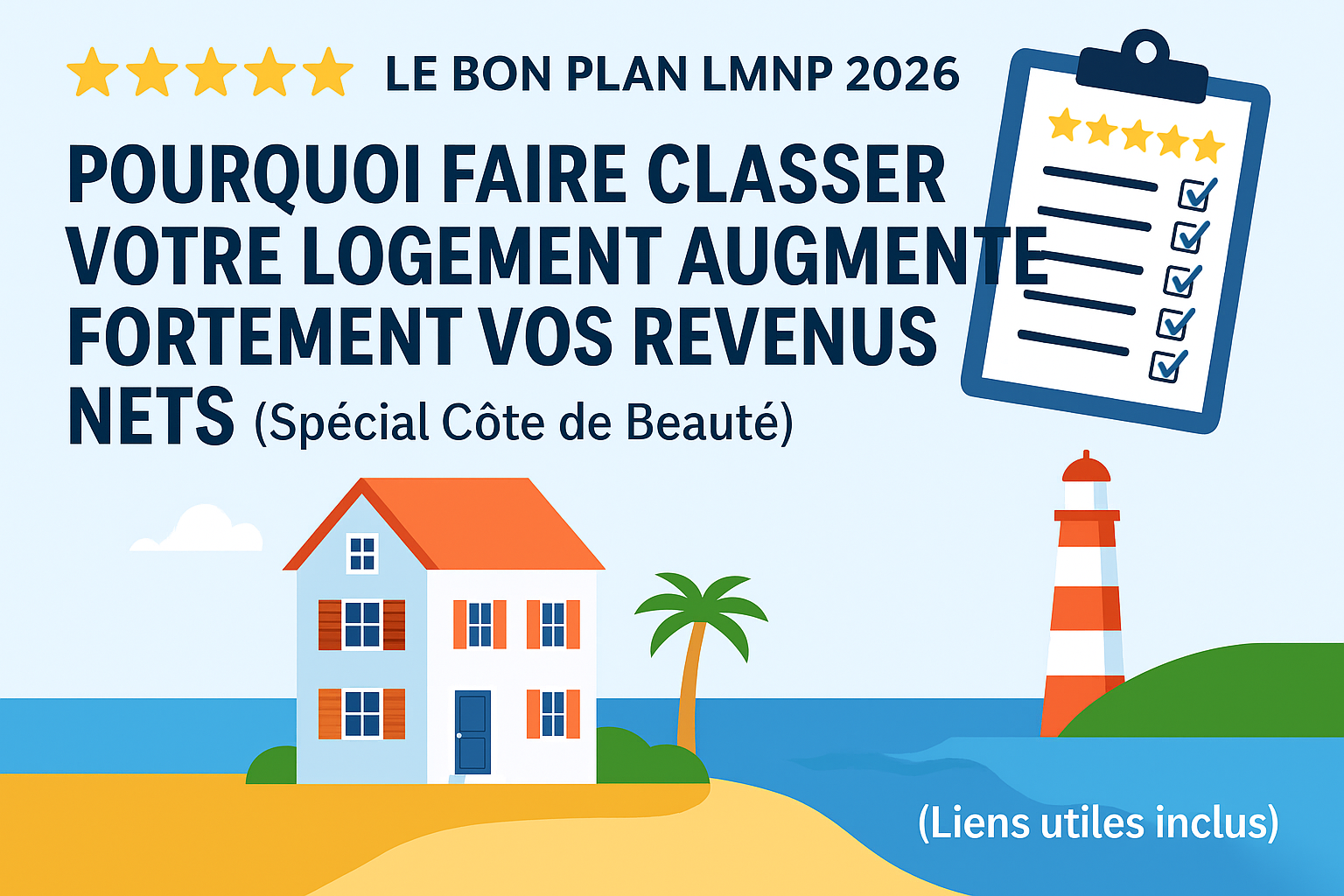
The 2026 LMNP plan: why having your property classified will significantly increase your net income

You rent your property to Meschers, Royan, Saint-Georges-de-Didonne, Vaux-sur-Mer, Talmont… ?
You are LMNP (or are you about to become one)?
And you're looking for leverage simple, legal and cost-effective to pay less tourist tax and less tax ?

🎉 Good news: Meublé de Tourisme classification (1 to 5 stars) is one of best LMNP levers in 2026, particularly in the Royan Atlantique Conurbation Community (CARA).

Here's why.👇


📌 1. Rankings: what are they?

Le Furnished Tourist Accommodation classification is an official certification issued by an accredited body (Atout France).

It awards 1 to 5 stars, based on a grid of more than 130 criteria:

  • equipment,
  • comfort,
  • developments,
  • services,
  • environment,
  • safety...

The classification is recognised:

  • by Airbnb / Booking,
  • by the town hall,
  • by the CARA,
  • by the tax,
  • and appears on the Official Cerfa declaration at the town hall.

💥 2. Classification lowers tourist tax (a lot)

In the Communauté d'Agglomération Royan Atlantique, the 2025-2026 fares are very clear.

A) CLASSIFIED accommodation: fixed rate per person per night

RankingRate (CARA + departmental tax)
⭐⭐⭐⭐⭐1,65 €
⭐⭐⭐⭐1,45 €
⭐⭐⭐1,25 €
⭐⭐1,05 €
0,85 €

➡️ Price list does not depend on the price of the night, Only the number of passengers.


❌ B) UNCLASSIFIED accommodation: proportional rate

👉 5 % of the price per night per person, excluding VAT, capped at €4.14
→ +10 % departmental tax = 4.55 max / person

🎯 The more expensive the night, the higher the tax.


📊 3. CHIFRATED comparison: classified vs unclassified

(Official CARA example - based on €100 / night for 2 people)

❌ UNCLASSIFIED

5 % × €100 = €5 → capped at €4.14
+10 % = 4.55 € / person / night
→ €9.10 / night for 2 people
63.70 € / week

✔ CLASSED (3★)

1.25 € / person / night
→ €2.50 / night for 2 people
17.50 € / week

🎉 Net savings : 46.20 € / week

300 to 600 € / season
1 000 € and more / year for a well-let property

If you are hosting 4 people :
➡️ savings double.


💸 Bonus: lower tourist tax = more bookings

Travellers watch the total price displayed, including tax.

Example for a couple:

  • Uncategorized : 109.10 € / night
  • Classified : 102.50 / night

➡️ Without touching your own price, you become more attractive.

Result:

  • better positioning in Airbnb searches,
  • more clicks,
  • more bookings,
  • higher net income.

💰 4. Ranking also improves your LMNP tax income

Since 2026 :

Type of accommodationMicro-BIC allowance
Uncategorized30 %
Classified as furnished tourist accommodation50 %
(71 % = deleted)**

🎯 The ranking no longer 71 %, but it remains significantly more advantageous than 30 %.

Example: €12,000 annual income

UncategorizedRated
Allowance30 %50 %
Tax base8 400 €6 000 €
Taxable difference2,400 in untaxed income

➡️ Even without the 71 %, the ranking significantly reduces the tax base.


📈 5. Ranking also improves your online visibility

The platforms enhance :

  • housing certified,
  • ads with increased confidence,
  • the criteria for quality checked.

A classified dwelling :

  • appears in the search filters,
  • inspires confidence,
  • converts better,
  • attracts more families and tourists from abroad,
  • increases occupancy rates 10 to 20 %.

🪙 6. The cost of classification is low... and immediately amortised

Average rates for Atout France-approved organisations :

  • Flat : 120 à 180 €
  • House : 180 à 250 €

Validity : 5 years

Amortisation via :

  • reduced tourist tax,
  • more advantageous tax treatment,
  • best performance on Airbnb / Booking.

👉 In most cases, ranking is profitable in 1 to 2 weeks' rental.


🧭 7. How do you classify your accommodation on the Côte de Beauté?

✔ Find an approved body

https://www.classement.atout-france.fr

✔ Preparing your home

CLM can help you :

  • check for missing criteria,
  • easily optimise your score,
  • aim for 3★ or 4★, the best effort/gain ratio.

✔ Have the visit carried out

The inspector checks the criteria → award → official publication.

✔ Update your ad

CLM takes care of everything on :

  • Airbnb
  • Booking
  • Abritel
  • Tourist tax portal
  • Cerfa town hall

🏆 8. Why does CLM strongly recommend ranking in 2026?

Because today is the day one of the best returns on investment in the LMNP sector.

AdvantageReal impact
Tourist tax divided by 2 to 4+300 to €1,500/year
Taxation (allowance 50 %)+1,000 to +3,000 €/year
Better visibility on Airbnb+10 to +20 % reservations
Low costAmortized in 1 to 2 weeks
Duration 5 yearsExceptional ROI

📊 Summary table - unclassified vs classified accommodation (basis €1,000)

ElementsUncategorizedRated
Price paid by the passenger1 000 €1 000 €
Platform Committee-150 €-150 €
Income after platform850 €850 €
Concierge service (20 % inc. VAT)-170 €-170 €
Income before tax680 €680 €
Micro-BIC tax allowance30 %50 %
Tax base476 €340 €
Taxes (30 %)-143 €-102 €
NET final proprietary537 €578 €
Net profitability53,7 %57,8 %

💬 Conclusion

🎉 The ranking is THE 2026 LMNP plan for property owners on the Côte de Beauté.

It is :

  • simple,
  • officially recognised,
  • tax benefits,
  • very profitable,
  • validated by the CARA, the Town Hall and the State.

And above all :

👉 It simultaneously increases
your attractiveness + your occupancy rate + your net income.


📞 Ready to classify your home?

CLM - Conciergerie Locative de Meschers can help you :

  • advice
  • preparation
  • optimisation
  • steps
  • ad updates
  • LMNP optimisation

Contact us for a free estimate of your potential earnings.

Holiday lettings: how much do you really have left once all the costs have been deducted (Version 2026)

Short-term rentals on the Côte de Beauté - Royan, Meschers, Saint-Georges-de-Didonne, Vaux-sur-Mer... - can be very profitable.
But between :

  • platform committee,
  • caretaker costs,
  • tourist tax,
  • LMNP taxation (2026 reform),

...understand real NET income is not so simple.

Visit the clearest possible analysis, using a concrete example:

➡️ a stay billed at €1,000 to the traveller


1️⃣ €1,000 charged to travellers: what does this amount really contain?

The €1,000 quoted on Airbnb / Booking includes :

  • the rent,
  • tourist tax, which is automatically collected by the platform and paid to the local authority.

🎯 The tourist tax has a direct impact on your appeal

A little-known point:

✔ A furnished holiday home listed benefits from a reduced tourist tax.

This involves :

  • a lower final price for the traveller,
  • a better position in the Airbnb / Booking results,
  • so more potential bookings.

Tourist tax is never income for the owner,
➡️ but lower tax increases your competitiveness.


2️⃣ Platform commission: approx. 15 %

Airbnb, Booking and Abritel charge an average commission of 15 %.

📌 Out of €1,000 :

  • -150 € commission
  • 850 € paid back to the owner

It is the first major reduction between the advertised price and your actual price.


3️⃣ Concierge fees: 20 % incl. VAT

A professional concierge service generally charges 18 to 25 % incl. VAT.

At CLM, our model is transparent: 20 % incl. VAT.

This fee includes :

  • ad management,
  • passenger communication,
  • assistance during your stay,
  • household coordination,
  • complete calendar and price management.

📌 Out of €850 :

  • -170 € INCL. VAT
  • 680 € before LMNP tax

4️⃣ LMNP 2026 taxation: allowance of 30 % or 50 % (depending on classification)

Since the reform (2025 income declared in 2026), the rules are :

NON-classified accommodation (unclassified furnished tourist accommodation)

  • Micro-BIC allowance: 30 %
  • Ceiling: €15,000
    ➡️ Beyond, compulsory actual scheme.

Accommodation classified as furnished tourist accommodation

  • Micro-BIC allowance: 50 %
  • Ceiling: €77,700

🎯 Classification always allows for tax treatment much more favourable than 30 %.

Tax assumption used :

👉 Overall marginal rate for income tax + social security contributions = 30 %


5️⃣ Real-life example 2026: how much do you really have left over from €1,000?

After the platform and concierge service, revenue is identical in both cases :

➡️ 680 before tax

The difference comes from exclusively the LMNP tax system.


📊 Summary table 2026 - unclassified vs. classified accommodation

(Based on a stay of €1,000 paid by the traveller)

ElementsUncategorizedClassified as furnished tourist accommodation
Price paid by the passenger1 000 €1 000 €
Platform Committee (15 %)-150 €-150 €
Income after platform850 €850 €
Concierge service (20 % inc. VAT)-170 €-170 €
Income before tax680 €680 €
Micro-BIC tax allowance30 %50 %
Tax base476 €340 €
Taxes (30 %)-143 €-102 €
NET final proprietary537 €578 €
Net return on price paid53,7 %57,8 %

🎯 Key facts

1) Classification improves both taxation and attractiveness

A classified home generates here +41 € net per stay.
Over the year, this can represent several thousand euros.

It also enables :

  • a lower tourist tax,
  • a lower final price,
  • a better conversion rate.

2) Platforms take an average of 15 %

A cost that is often underestimated, but unavoidable.


3) Concierge service (20 % incl. VAT) makes everything easier

In a professional holiday let, it :

  • maximises customer satisfaction,
  • reduces your constraints,
  • improves your occupancy rate.

4) LMNP tax depends heavily on classification

  • 70 % of income is taxable unclassified (allowance 30 %)
  • 50 % only classified

The difference is structural, and very significant.


🧠 Conclusion

Seasonal rental on the Côte de Beauté remains highly profitable in 2026...
provided that two major levers are optimised:

1️⃣ Classification of furnished tourist accommodation

✔ improve your attractiveness
✔ réduit votre taxe de séjour
✔ divise votre base imposable par deux

2️⃣ Une gestion professionnelle et optimisée

✔ maximise le revenu net
✔ simplifie l’exploitation
✔ sécurise l’expérience voyageurs

At CLM - Conciergerie Locative de Meschers, nous accompagnons les propriétaires sur :

  • la fixation des prix,
  • la fiscalité LMNP,
  • l’obtention du classement,
  • la gestion opérationnelle,
  • le suivi des performances.

👉 Vous souhaitez connaître votre revenu NET exact pour votre logement ?

CLM réalise gratuitement une simulation personnalisée basé sur :

  • votre logement,
  • votre saisonnalité,
  • votre stratégie tarifaire,
  • votre situation fiscale.

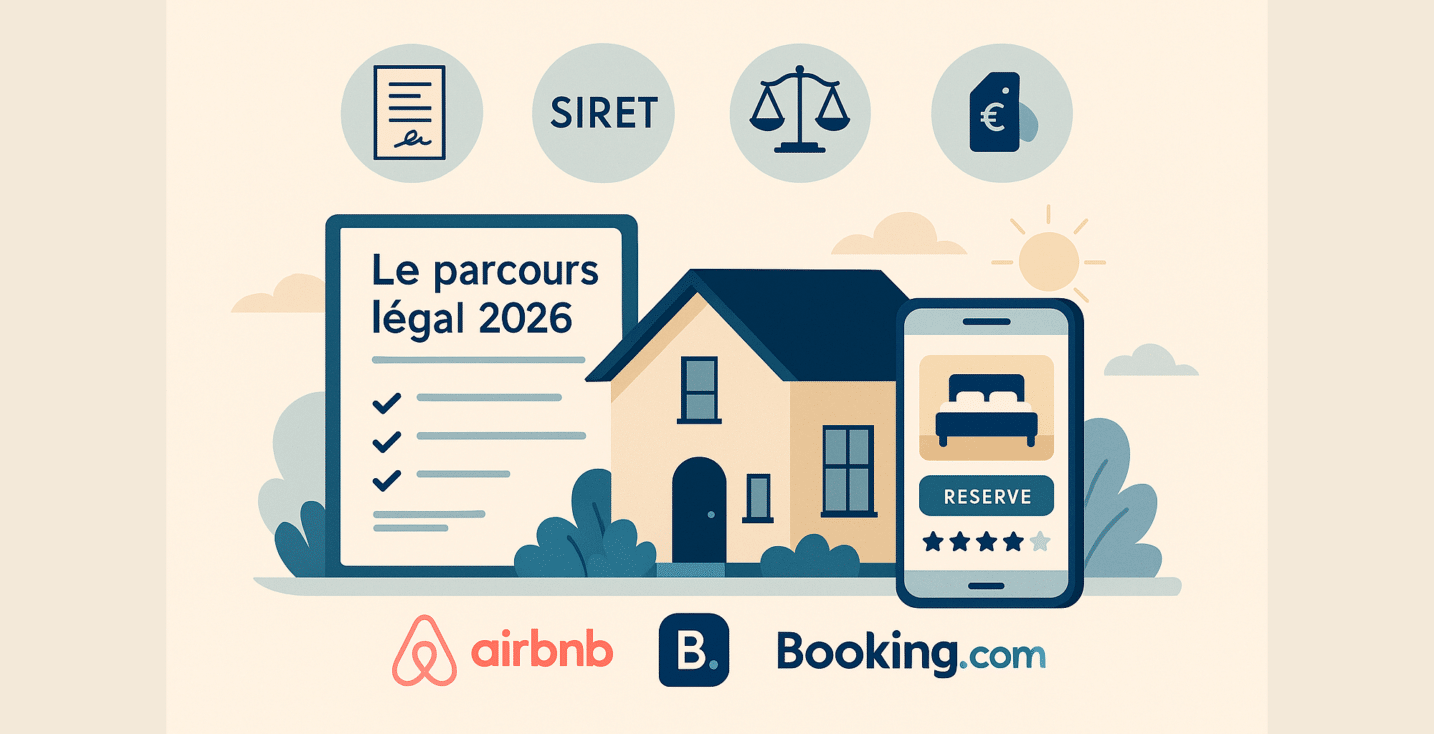
The 2026 legal route: renting your accommodation on Airbnb, Booking or Abritel in full compliance

Vous souhaitez louer votre logement sur Airbnb, Booking or Abritel, tout en restant parfaitement en règle avant de confier la gestion à CLM - Conciergerie Locative de Meschers ?

Visit le parcours légal le plus simple possible, mis à jour pour 2026, étape par étape, avec tous les liens officiels.


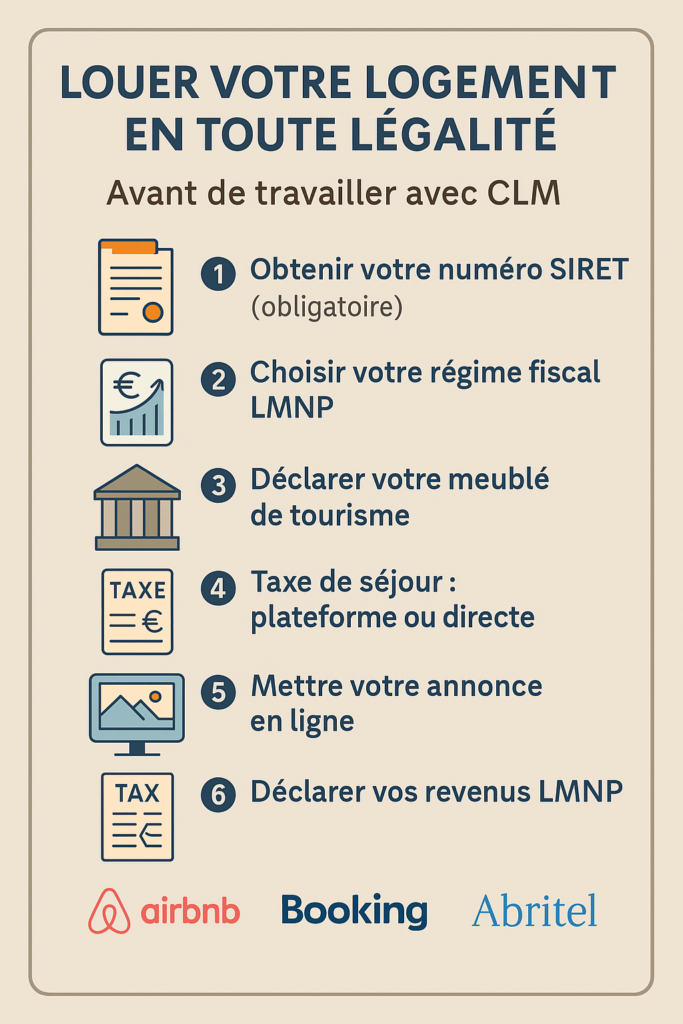
1️⃣ Obtenir votre numéro SIRET (obligatoire pour toute location meublée)

Pour louer un logement meublé, même quelques jours par an, vous devez avoir un SIRET number.
Ce numéro vous inscrit automatiquement au statut LMNP (Loueur Meublé Non Professionnel).

✔️ Demande 100 % en ligne :
👉 https://procedures.inpi.fr/?/declaration-p0i

Lorsqu’on vous demande l’activité, sélectionnez :
6820A – Location de logements meublés

Référence officielle :
👉 https://www.entreprises.gouv.fr/fr/meubles-de-tourisme

ℹ️ CLM peut vous assister si vous n’êtes pas à l’aise avec l’inscription.


2️⃣ Choisir votre régime fiscal LMNP (Micro-BIC ou Réel) – Version 2026

Une fois votre SIRET obtenu, vous devez choisir un régime fiscal.

Depuis la réforme 2025/2026, les règles changent selon le type de location :


Micro-BIC (régime par défaut)

👉 Pour un meublé de tourisme not classified (Airbnb, Booking, Abritel)

  • Plafond micro-BIC : 15 000 €/an
  • Abattement : 30 %

➡️ Au-delà de 15 000 €, micro-BIC impossible, vous passez au réel obligatoire.


👉 Pour un meublé de tourisme listed ou location meublée longue durée

  • Plafond micro-BIC : 77 700 €
  • Abattement : 50 %

Régime réel (sur option ou obligatoire si recettes > 15 000 € non classé)

Vous pouvez déduire :

  • travaux,
  • intérêts d’emprunt,
  • ameublement,
  • amortissement du logement,
  • conciergerie, ménage, charges,
  • taxe foncière…

➡️ Le réel est souvent le plus avantageux pour la location saisonnière.

Informations officielles :
👉 https://www.impots.gouv.fr/location-meublee


3️⃣ Déclarer votre meublé de tourisme en mairie

La déclaration est obligatoire pour toute location saisonnière dans la plupart des communes de la Côte de Beauté, notamment :

✔️ Page officielle simple (formulaire + explications) :

👉 https://www.service-public.fr/particuliers/vosdroits/R14321

Formulaire Cerfa direct (14004*04) :
👉 https://www.formulaires.service-public.fr/gf/cerfa_14004.do

ℹ️ CLM peut le remplir avec vous.


4️⃣ Taxe de séjour : automatique ou déclaration manuelle

✔ Si vous louez via Airbnb, Booking, Abritel

La plateforme :

  • calcule automatiquement la taxe,
  • la collecte auprès du voyageur,
  • la reverse à la collectivité.

👉 Vous n’avez aucune action à réaliser.


✔ Si vous louez en direct (site personnel, bouche-à-oreille, clientèle locale)

Les communes du territoire utilisent la plateforme officielle : 👉 https://royanatlantique.taxesejour.fr

Vous devez :

  1. créer un compte,
  2. declare your overnight stays,
  3. régler la taxe due.

ℹ️ CLM peut vous accompagner dans la création et l’utilisation du compte, sans intervenir dans les paiements (Hoguet law).


5️⃣ Mettre votre annonce en ligne (CLM peut tout gérer)

CLM peut s’occuper de :

  • créer ou optimiser votre annonce Airbnb / Booking / Abritel,
  • réaliser des photos efficaces,
  • rédiger un texte attractif,
  • paramétrer calendrier, prix, restrictions,
  • synchroniser vos canaux de réservation.

👉 Vous pouvez tout déléguer.


6️⃣ Déclarer vos revenus LMNP (1 fois par an)

Dans votre espace impots.gouv.fr, rubrique :
👉 “Revenus industriels et commerciaux non professionnels (BIC)”

Documentation officielle :
👉 https://www.impots.gouv.fr/location-meublee

ℹ️ CLM peut vous fournir les montants à déclarer et vous indiquer la ligne exacte.


7️⃣ Les assurances indispensables du propriétaire (LMNP)

Avant d’accueillir votre premier voyageur, vérifiez que votre logement est assuré pour l’activité saisonnière.

✔ Assurance Propriétaire Non-Occupant (PNO)

Indispensable pour :

  • dégâts des eaux, incendies, explosions,
  • dommages en votre absence,
  • responsabilité civile du propriétaire,
  • recours des locataires,
  • relogement / pertes d’exploitation selon contrat.

✔ Assurance RC du propriétaire bailleur

Souvent incluse dans la PNO.

✔ Assurance RC Professionnelle de la conciergerie (CLM)

Protège contre :

  • dommages lors des prestations,
  • interventions,
  • gestion locative.

Résumé pratique (version 2026)

ÉtapeActionLien
1Obtenir un SIREThttps://procedures.inpi.fr/?/declaration-p0i
2Choisir Micro-BIC / Réelhttps://www.impots.gouv.fr/location-meublee
3Déclarer le meublé en mairiehttps://www.service-public.fr/particuliers/vosdroits/R14321
4Taxe via plateformesAutomatique
4 bisTourist tax https://royanatlantique.taxesejour.fr
5Mise en ligne de l’annonceCLM
6Déclaration LMNP annuellehttps://www.impots.gouv.fr/location-meublee

Conclusion

With CLM - Conciergerie Locative de Meschers, vous louez :

✔ en toute conformité,
✔ simplement,
✔ avec un accompagnement local, humain et professionnel,
✔ sans perdre de temps dans l’administratif.

Vous êtes propriétaire à Meschers, Royan, Saint-Georges ou alentours ?
➡️ Nous pouvons vous accompagner dès aujourd’hui.

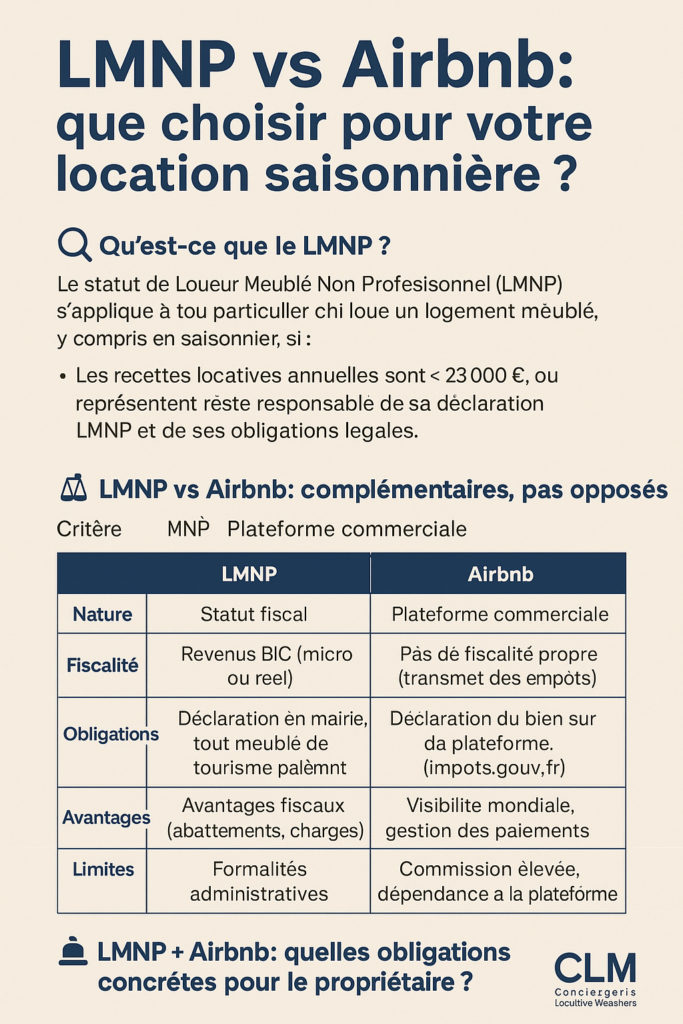
LMNP vs Airbnb: what should you choose for your holiday let?

De nombreux propriétaires de Royan, Meschers-sur-Gironde or Saint-Georges-de-Didonne nous posent la même question :
« Dois-je être LMNP ou dois-je utiliser Airbnb ? »

➡️ En réalité, ce n’est pas un choix :

  • LMNP est un statut fiscal obligatoire,
  • Airbnb est une plateforme commerciale facultative.

At CLM - Conciergerie Locative Meschers, nous clarifions les deux pour éviter toute confusion — surtout depuis les nouvelles règles fiscales applicables en 2026.


🔎 Qu’est-ce que le LMNP (version 2026) ?

Le LMNP – Loueur Meublé Non Professionnel — est le statut fiscal de toute personne louant un logement meublé, y compris en location saisonnière, si au moins une des conditions suivantes est remplie :

  • Les recettes meublées annuelles sont < 23 000 €,
    or
  • Elles restent inférieures aux autres revenus d’activité du foyer.

➡️ Dans ce cas, vos revenus sont imposés dans la catégorie BIC (micro-BIC ou régime réel).

✔ Quels régimes fiscaux LMNP choisir en 2026 ?

Les règles ont changé avec la réforme 2025/2026 :

1️⃣ Location saisonnière – Meublé de tourisme NON classé

  • Plafond micro-BIC : 15 000 €
  • Abattement : 30 %
    ➡️ Au-delà de 15 000 €, compulsory actual scheme

2️⃣ Meublé de tourisme CLASSÉ (1 à 5 étoiles)

  • Plafond micro-BIC : 77 700 €
  • Abattement : 50 %

3️⃣ Location meublée longue durée

  • Plafond micro-BIC : 77 700 €
  • Abattement : 50 %

👉 En location saisonnière, la plupart des propriétaires basculent désormais au régime réel, car ils dépassent les 15 000 € de recettes.


🔎 Qu’est-ce qu’Airbnb ?

Airbnb est uniquement une plateforme de diffusion qui met en relation propriétaires et voyageurs.

Elle permet :

  • de publier une annonce,
  • de gérer les réservations et les paiements,
  • de collecter automatiquement la taxe de séjour pour le territoire Royan Atlantique,
  • d’offrir une visibilité internationale.

Airbnb n’est pas un statut fiscal.
L’utilisation d’Airbnb ne remplace pas les obligations LMNP.


⚖️ LMNP vs Airbnb : complémentaires, pas opposés

Voici la comparaison claire :

➡️ Un propriétaire LMNP peut utiliser Airbnb, Booking, Abritel, ou aucune plateforme.
➡️ Mais tout propriétaire utilisant Airbnb est nécessairement LMNP, sauf cas très rares de statut professionnel (LMP).


📌 LMNP + Airbnb : vos obligations en 2026

Un propriétaire qui loue via Airbnb doit respecter toutes les obligations suivantes :

✔ 1. Déclaration d’activité

Déposer un formulaire P0i to obtain a SIRET number.

✔ 2. Déclaration en mairie

Toute location saisonnière, classée ou non, doit être déclarée comme meublé de tourisme.

✔ 3. Fiscalité LMNP

Déclarer ses revenus en micro-BIC (30 % ou 50 % d’abattement) ou actual regime.

✔ 4. Taxe de séjour

Airbnb la collecte automatiquement pour l’agglomération Royan Atlantique, mais le propriétaire reste légalement responsable de sa conformité.

✔ 5. Transparence des revenus

Depuis 2020, Airbnb transmet automatically vos recettes à l’administration fiscale.

➡️ Impossible d’effectuer une location « discrète » : tout est communiqué.


📌 Exemple concret (adapté 2026)

Un propriétaire à Meschers loue un appartement via Airbnb.

  • Recettes 2025 : 10 000 €
  • Airbnb prélève sa commission
  • Le propriétaire reçoit l’information fiscale automatiquement transmise aux impôts

En LMNP, il doit :

  1. Avoir un SIRET
  2. Déclarer 10 000 € dans la catégorie BIC :
    • en micro-BIC 30 % (location non classée)
      → imposé sur 7 000 €
    • ou au actual regime s’il souhaite déduire frais + amortissements
  3. Vérifier la tourist tax (collectée automatiquement via Airbnb)

🚀 Conclusion

LMNP et Airbnb ne s’opposent pas, ils sont complémentaires :

  • LMNP = cadre fiscal obligatoire
  • Airbnb = outil optionnel pour diffuser votre annonce

👉 En clair :
Un propriétaire sur Airbnb doit être LMNP, avoir un SIRET, déclarer ses revenus, et respecter les obligations locales (mairie, taxe de séjour).

At CLM - Conciergerie Locative Meschers, nous accompagnons les propriétaires pour :

  • être en règle fiscalement (LMNP, P0i, SIRET),
  • gérer les déclarations mairie / taxe de séjour,
  • optimiser la diffusion (Airbnb, Booking, site CLM),
  • augmenter la rentabilité (classement, fiscalité, gestion locative).

➡️ Vous êtes propriétaire à Royan, Meschers ou Saint-Georges-de-Didonne et souhaitez louer sans contraintes ? Contactez CLM dès aujourd’hui.

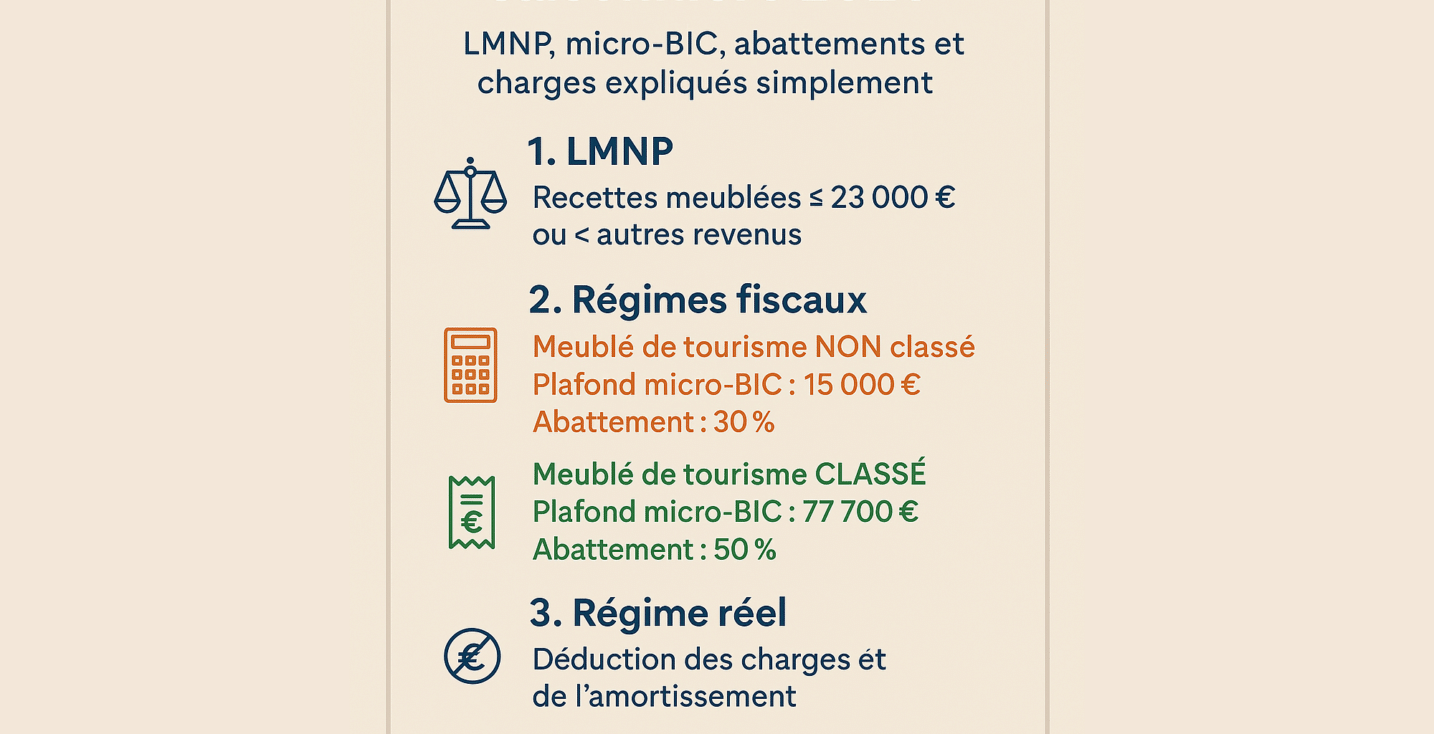
Seasonal rental taxation 2026: LMNP, micro-BIC, allowances and charges explained simply (including useful links)

La fiscalité du LMNP a profondément changé avec la réforme entrée en vigueur pour les revenus 2025, déclarés en 2026.
Beaucoup d’informations circulant sur le web sont déjà obsolètes (plafonds 77 700 €, abattement 50 %, abattement 71 %, etc.).

Visit les règles fiscales exactes applicables en 2026, pour les locations saisonnières à Meschers-sur-Gironde, Royan et la Côte de Beauté.


⚖️ 1. LMNP : rappel du statut (inchangé)

Vous êtes LMNP si au moins une des conditions suivantes est remplie :

  • Vos recettes meublées < 23 000 € / an, OU
  • Vos recettes meublées sont < à vos autres revenus d’activité du foyer fiscal.

👉 Ce statut ne change pas en 2026.

🔹 Ce seuil de 23 000 € n’a rien à voir avec le micro-BIC.
Il sert uniquement à distinguer LMNP vs LMP.


📊 2. Régimes fiscaux LMNP 2026 : micro-BIC vs réel

⚠️ C’est ici que tout a changé en 2025/2026.
Il faut distinguer trois cas, car les abattements ne sont plus les mêmes.


🟦 CAS 1 — Location meublée “classique” (pas une location saisonnière)

Ex : résidence principale d’un locataire, étudiants, bail mobilité, etc.

  • Plafond micro-BIC : 77 700 €/an
  • Abattement forfaitaire : 50 %

👉 Ce régime n’a pas changé.


🟧 CAS 2 — Meublé de tourisme not classified

(Airbnb / Booking / courte durée – cas le plus courant)

➡️ C’est là que la réforme est majeure.

À partir des revenus 2025, donc pour la déclaration 2026 :

  • Plafond micro-BIC : 15 000 €
  • Abattement : 30 % (au lieu de 50 % avant réforme)

Donc :

Recettes annuellesRégime possible
≤ 15 000 €micro-BIC 30 % ou réel
> 15 000 €RÉEL obligatoire

👉 La plupart des propriétaires louant un bien saisonnier vont donc bascule automatiquement au réel si leurs recettes dépassent 15 000 € (ce qui est très fréquent sur la Côte de Beauté).


🟩 CAS 3 — Meublé de tourisme listed (1 to 5 stars)

La réforme a supprimé l’ancien abattement 71 %.

À partir de 2025/2026 :

  • Plafond micro-BIC : 77 700 €
  • Abattement : 50 % (au lieu de 71 %)
SituationRégime micro-BIC
Bien classé50 % d’abattement jusqu’à 77 700 €
Bien non classé30 % d’abattement jusqu’à 15 000 €

👉 Le classement meublé de tourisme redevient intéressant, car il permet :

  • un abattement de 50 % (vs 30 % sinon)
  • un plafond beaucoup plus élevé (77 700 €)

🧾 3. Régime réel 2026 : toujours le plus avantageux en location saisonnière

Le actual regime devient incontournable pour la plupart des loueurs saisonniers (recettes > 15 000 €).

Vous pouvez déduire :

  • Frais de conciergerie (CLM)
  • Cleaning
  • Charges de copropriété
  • Taxe foncière
  • Assurance PNO
  • Intérêts d’emprunt
  • Travaux
  • Frais de comptable
  • Amortissement du logement et du mobilier

➡️ Grâce aux amortissements, de nombreux propriétaires LMNP ont en pratique 0 € d’impôt sur plusieurs années.


💶 4. TVA et location saisonnière (aucun changement)

En LMNP classique (même saisonnier), vous ne facturez not de TVA.

TVA uniquement si vous fournissez ≥ 3 de ces 4 services :

  1. Petit-déjeuner
  2. Nettoyage quotidien
  3. Fourniture du linge régulière
  4. Réception physique ou présence permanente

👉 Dans 99 % des cas, vous restez non assujetti.

La conciergerie, elle, facture sa TVA, mais pas sur vos loyers.


📌 5. Exemple concret (compatible 2026)

Un propriétaire de Royan encaisse 20 000 €/an en saisonnier not classified.

Micro-BIC impossible

→ seuil 15 000 € dépassé.

Au réel

Charges : 7 000 €
Amortissements : 6 000 €
Résultat fiscal : 20 000 – 13 000 = 7 000 €

👉 Dans de nombreux cas, l’amortissement suffit à gommer totalement le bénéfice, surtout les premières années.


🧠 6. Résumé ultra-clair pour 2026

Type de locationPlafond micro-BICAllowanceCommentaire
Meublé classique (non saisonnier)77 700 €50 %inchangé
Meublé de tourisme NON classé15 000 €30 %énorme restriction
Meublé de tourisme CLASSÉ77 700 €50 %remplacement de l’ancien 71 %

🚀 Conclusion

La réforme fiscale 2025/2026 modifie profondément la rentabilité des locations saisonnières.
Pour la grande majorité des propriétaires :

➡️ Micro-BIC devient inutilisable (seuil trop bas : 15 000 €).
➡️ Le régime réel devient obligatoire — et souvent plus avantageux.
➡️ Le classement meublé de tourisme redevient stratégique (50 % d’abattement et plafond 77 700 €).

At CLM - Conciergerie Locative Meschers, nous accompagnons les propriétaires pour :

  • optimiser leur fiscalité LMNP,
  • choisir le bon régime,
  • préparer les documents pour l’expert-comptable,
  • obtenir le classement meublé de tourisme si nécessaire.