Fiche de police en location saisonnière (Airbnb, etc.) : obligation, responsabilités, et que faire si un voyageur refuse de signer ?

Obligation légale, responsabilités, et que faire si un voyageur refuse de signer – même s’il est déjà sur place

Sur les groupes Facebook d’entraide entre conciergeries et hôtes Airbnb, le sujet revient sans cesse :

“Personne ne la fait”,
“C’est trop lourd”,
“Il faut l’envoyer sous 48h sur une plateforme”,
“Et si le voyageur refuse ?”

Résultat : beaucoup d’acteurs de la location saisonnière avancent avec des informations partielles… jusqu’au jour où un voyageur refuse de signer, parfois une fois déjà sur place.

Voici la réalité juridique, sans jargon, et surtout quoi faire concrètement, y compris dans les situations non anticipées.


1) La fiche individuelle de police : une obligation légale, pas une option

In France, tout loueur ou exploitant d’un hébergement touristique (meublé de tourisme, chambre d’hôtes, hôtel, camping, etc.) doit faire remplir une fiche individuelle de police à chaque client de nationalité étrangère (y compris ressortissants de l’Union européenne), dès l’arrivée.

👉 Source officielle – Service-Public.fr
https://www.service-public.fr/particuliers/vosdroits/F33458

Ce que prévoit la loi

  • La fiche doit être complétée et signée par le voyageur étranger
  • Elle doit être conservée pendant 6 mois
  • Elle doit être remise uniquement sur demande de la police ou de la gendarmerie
  • La transmission peut être dématérialisée

👉 Source – Code de l’entrée et du séjour des étrangers (CESEDA), art. R814-1 (Légifrance)
https://www.legifrance.gouv.fr/codes/article_lc/LEGIARTI000033334540/

⚠️ Il n’existe pas d’obligation générale d’envoi automatique sous 24h ou 48h sur une plateforme pour la fiche de police. Cette confusion vient souvent d’autres obligations (taxe de séjour, démarches communales, etc.).


2) Conciergerie sans carte G : peut-elle gérer la fiche de police ?

Oui, en pratique, une conciergerie peut :

  • faire remplir la fiche,
  • la conserver,
  • la transmettre sur demande des autorités,

car il s’agit d’une obligation liée à l’hébergement et à l’ordre public, et non d’un acte de transaction ou de gestion locative au sens de la carte G.

👉 Le point clé n’est pas la carte G, mais la clarté contractuelle :

  • qui est juridiquement le loueur/exploitant (souvent le propriétaire),
  • qui collecte la fiche,
  • qui la conserve,
  • qui répond en cas de demande de la police ou de la gendarmerie.

3) RGPD et données personnelles : ce qui est autorisé (et ce qui ne l’est pas)

La CNIL encadre clairement le sujet :

  • aucune formalité spécifique à déclarer,
  • les données ne peuvent être utilisées que pour cette obligation légale,
  • elles ne peuvent être transmises qu’aux forces de l’ordre, sur demande,
  • elles doivent être conservées de manière sécurisée puis détruites après 6 mois.

👉 Source – CNIL
https://www.cnil.fr/fr/cnil-direct/question/fiche-individuelle-de-police-pour-les-clients-etrangers-dun-etablissement-de

👉 Modèle officiel de fiche (arrêté) – Légifrance
https://www.legifrance.gouv.fr/loda/id/JORFTEXT000031285813/


4) Qui est responsable si la fiche n’est pas faite ?

Les textes visent le loueur / exploitant de l’hébergement.
C’est donc lui qui est juridiquement tenu de l’obligation.

👉 Source – Service-Public.fr
https://www.service-public.fr/particuliers/vosdroits/F33458

En pratique

Lors d’un contrôle, l’administration ne s’intéresse pas à savoir “qui devait le faire” :

  • elle demande les fiches,
  • elle vérifie qu’elles existent et sont produisibles rapidement.

👉 D’où l’importance d’un process clair and a responsable identifié.


5) Le vrai problème : “le voyageur refuse de signer”

C’est rare… jusqu’au jour où ça arrive.

Exemple réel vu sur Facebook :

“Deux voyageurs étrangers refusent de signer la fiche et ne communiquent pas. Ils sont déjà là. Que faire ?”

Distinguer deux choses ESSENTIELLES

A) Le contrat de location / règlement intérieur

Sur Airbnb, un hôte peut demander un contrat uniquement si c’est annoncé avant la réservation.
Sinon, le voyageur peut refuser.

👉 Source Airbnb – Contrats
https://www.airbnb.fr/help/article/465

B) La fiche de police

La fiche de police n’est pas une option contractuelle.
C’est une obligation légale française pour les voyageurs étrangers.

👉 Source – Service-Public.fr
https://www.service-public.fr/particuliers/vosdroits/F33458

➡️ Refuser de la remplir empêche légalement la poursuite normale de l’hébergement.


6) “Airbnb dit qu’on ne doit pas vérifier l’identité” : la nuance importante

Airbnb précise que :

  • l’hôte ne reçoit pas automatiquement les pièces d’identité,
  • MAIS l’hôte peut demander une pièce d’identité après la réservation if :
    • c’est annoncé dans l’annonce,
    • et nécessaire pour des raisons légales ou de conformité.

👉 Source Airbnb
https://www.airbnb.fr/help/article/1237

➡️ Collecter une fiche de police n’est pas interdit, c’est encadré.


7) CAS D’URGENCE : les voyageurs sont déjà là et refusent de signer

C’est le scénario le plus stressant. Voici la seule procédure à suivre, sans se mettre en tort.

❌ Ce qu’il ne faut JAMAIS faire

  • expulser physiquement (“manu militari”),
  • bloquer l’accès par la force,
  • couper eau / électricité,
  • rester silencieux vis-à-vis d’Airbnb.

Ces comportements te mettent immédiatement en risque juridique.


✅ La procédure correcte (pas à pas)

Étape 1 — Tout écrire immédiatement dans la messagerie Airbnb

Message factuel, sans émotion :

“Bonjour,
Conformément à la réglementation française applicable aux hébergements touristiques, une fiche de police doit être complétée par tout voyageur de nationalité étrangère dès l’arrivée.
Malgré plusieurs demandes, vous refusez de compléter ce document obligatoire.
Sans cette formalité légale, nous ne sommes pas en mesure de finaliser votre accueil.”

➡️ C’est la preuve clé.


Étape 2 — Contacter Airbnb immédiatement (téléphone ou chat)

Dire clairement :

  • obligation légale française,
  • refus explicite du voyageur,
  • impossibilité légale de maintenir l’hébergement,
  • demande d’annulation sans pénalité.

👉 Demander :

  • a numéro de dossier,
  • a note au dossier.

Étape 3 — Donner une dernière chance écrite

Toujours dans Airbnb :

“Sans complétion de la fiche de police d’ici XX minutes, nous serons contraints de demander l’annulation de la réservation pour non-respect des obligations légales locales.”


Étape 4 — Annulation via Airbnb

Si Airbnb valide :

  • ne pas remettre les clés / accès,
  • laisser la plateforme gérer le relogement,
  • rester calme et factuel.

➡️ Ce n’est pas une expulsion, c’est une impossibilité légale d’accueil.


8) Et s’ils ont déjà dormi une nuit ?

Même logique :

  • tout documenter,
  • contacter Airbnb immédiatement,
  • ne pas user de la force,
  • laisser la plateforme arbitrer.

Airbnb préférera annuler et reloger plutôt que gérer un incident légal local.


9) Comment éviter que ça se reproduise

La fiche de police ne doit jamais être découverte au check-in.

Bonnes pratiques :

  • mention claire dans l’annonce,
  • message automatique J-2,
  • formulaire obligatoire avant remise des clés,
  • pas de clés tant que ce n’est pas complété.

10) Conciergerie ↔ propriétaire : se protéger contractuellement

Une clause n’efface pas la loi, mais elle évite le chaos.

À prévoir :

  • mandat explicite de collecte,
  • désignation du responsable de conservation,
  • durée 6 mois + destruction,
  • procédure en cas de demande des autorités,
  • clause de coopération.

À retenir (phrase clé)

Un voyageur étranger qui refuse de remplir la fiche de police se place lui-même en situation empêchant légalement la poursuite de l’hébergement ; la solution passe par Airbnb et la traçabilité écrite, jamais par la contrainte.


Official sources

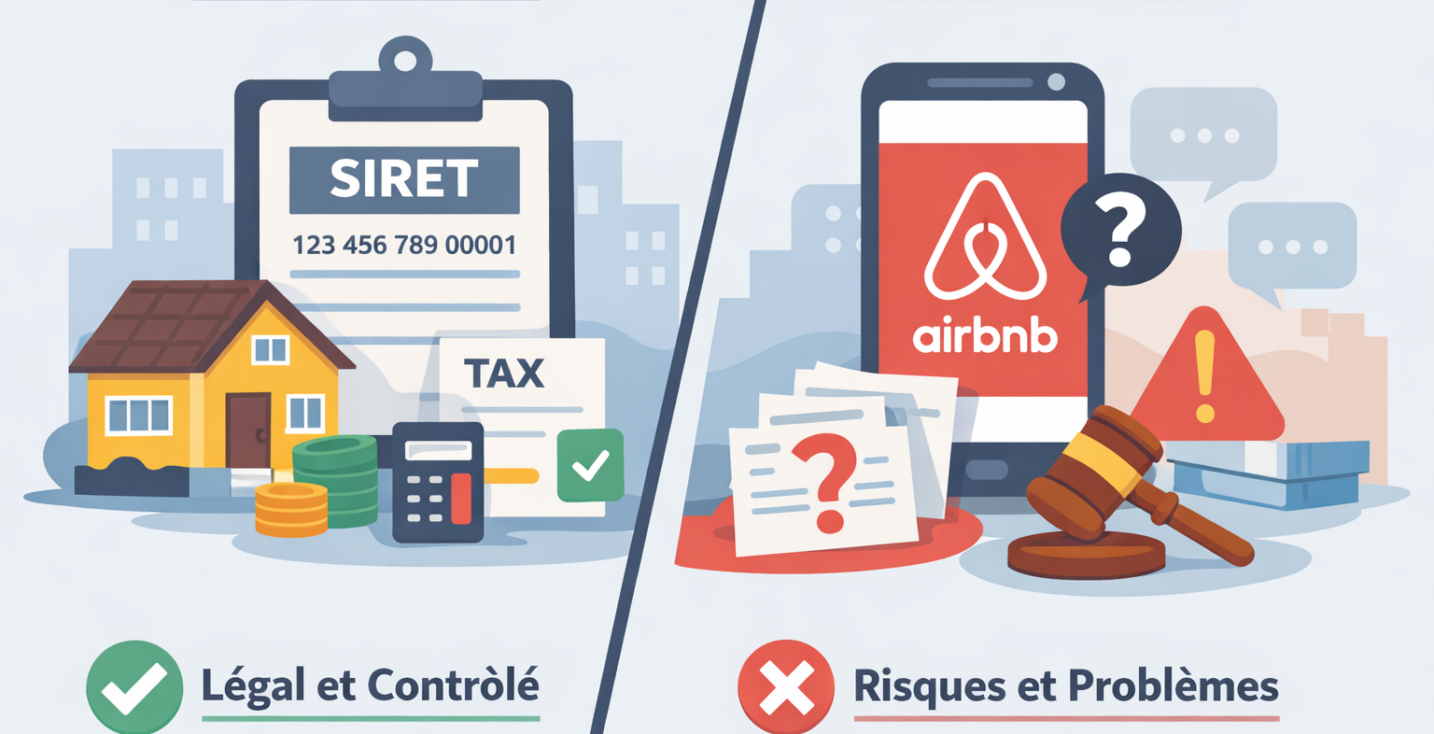
Why legally register your LMNP business (SIREN/SIRET) instead of “letting Airbnb manage it”?

We often hear: «I rent on Airbnb, they collect the tourist tax, they send me a recap... so that's enough.’
In practice, Airbnb (and other platforms) can manage a part of the traveller experience, but not the legal existence of your furnished rental activity in France.

And above all: registering LMNP (Guichet unique → SIRET/SIREN) is not just a formality “for the administration”. It's also what gives you the hand, It protects you and saves you from a number of nasty surprises.


LMNP: it's not a “status”, it's a declarable activity

LMNP describes a furnished rental activity carried out on a non-professional basis. Since 1 January 2023, LMNP activity has required a online registration via the formalities desk and obtaining a SIRET number (in 15 days from the start of the rental period).

In practical terms: even if you only rent on Airbnb, registration doesn't just happen“.


What Airbnb does... and what Airbnb will never do for you

Airbnb can

  • provide you with documents and summaries,
  • apply certain platform-related rules,
  • and, above all, to collect/transmit tax information under DAC7 (EU).

Airbnb cannot (and must not)

  • declare the start of your LMNP business,
  • choose your tax system (micro-BIC vs réel),
  • managing your off-platform tax obligations“ (e.g. CFE, consistency of declarations),
  • or secure your business if you also rent via Booking/Abritel/direct.

On impots.gouv.fr, the authorities are very clear: registration is used in particular to obtain a SIRET, publicise the existence of the business, and indicate the tax regime chosen.


The real advantages of having a SIREN/SIRET (and of doing it early)

1) You're square (and you sleep better)

The number one benefit is peace of mind: you declare your activity, you obtain your identifiers, and you take the steps required by the authorities (including the 15-day deadline).

2) You regain control over your tax situation (and often your profitability)

The “sinews of war” in LMNP is the tax choice and its implementation (micro-BIC vs réel, charges, depreciation, etc.).
Without your own registration, you are more likely to :

  • choose the wrong frame,
  • choose it too late,
  • or find yourself having to “catch up” on items when you file your tax return.

And this rarely has a neutral effect on the result.

3) You put your case on a professional footing (bank, accountant, insurance companies, partners)

A SIRET is a simple “marker”: your business exists, it is identified, and your file becomes much easier to read when a third party asks you for information (accountant, bank, service provider, etc.).

4) You are no longer dependent on a platform

Today Airbnb, tomorrow :

  • Booking,
  • Abritel,
  • your site,
  • or direct bookings.

Your SIRET does not change your marketing strategy.

5) You are consistent with the reality of 2023+: platform transparency is increasing (DAC7)

DAC7 requires Airbnb to collect and transmit tax information on hosts receiving income via the platform. To put it plainly: “I'm not doing anything” makes less and less sense.


The (very real) disadvantages of not doing so

1) You put off doing something you have to do... and you often end up doing it in a hurry

The most common situation is that you wait until “later” and then have to regularise the situation at the wrong time (tax return, change of platform, request for supporting documents, etc.). But the obligation + the 15-day deadline exist.

2) You potentially lose money (wrong tax choice, wrong implementation)

The No. 1 risk is not the immediate fine: it's the loss of earnings (incorrect engine speed, non-optimised loads, framing errors).

3) You are exposing yourself to tax inconsistencies (CFE, returns, supporting documents)

Furnished lettings come with a number of obligations, including CFE (with exemptions in certain cases, notably where receipts are ≤ €5,000).
Airbnb doesn't manage this “for you”, and the day it drops, it becomes your subject.

4) Your “strategy” is based on a belief: “Airbnb = compliance”.”

Airbnb can do useful things, but the tax authorities point out that obtaining a SIRET and declaring that they are starting up their business.


OK... and how do we do it?

For the practical part (the right choices to tick on the Guichet unique INPI, step by step), we have detailed everything here:

👉 Setting up your LMNP business on the Guichet unique (INPI): which options to choose, step by step


Conclusion

Registering as an LMNP is not about “pleasing the authorities”. It's about :

  • comply,
  • secure your income,
  • keep control of your tax affairs,
  • and not be dependent on a platform whose rules may change.

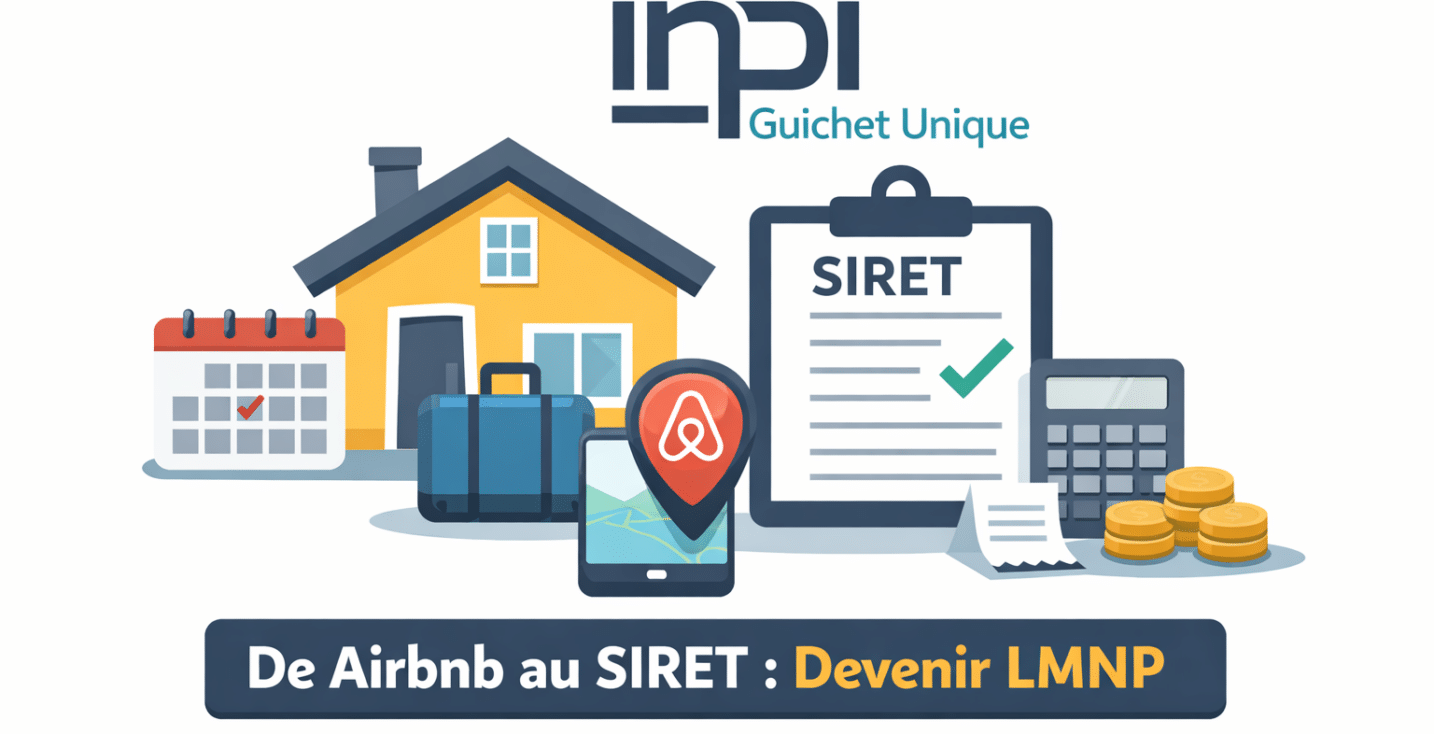
Setting up your LMNP business on the Guichet unique (INPI): which options to choose, step by step

You wish to register a non-professional furnished rental (LMNP) to obtain a SIRET and be “in order” fiscally? Since the introduction of the One-stop shop, If you want to register your company, you can do so online via INPI (business formalities). The trickiest part isn't the paperwork... it's getting the right information. tick the right options to avoid mistakes (such as confusing “micro-entrepreneur” with “micro-BIC”).

Here's a simple, practical, no-nonsense guide.

When you start out in furnished rental, you often hear: “Airbnb takes care of everything”.”. In reality, Airbnb can manage a part (e.g. tourist tax on bookings made with them), but not what comes under your registration and your tax obligations.

✅ INPI (Guichet unique) link ready to click


1) SIREN vs SIRET: what is it and why do you need it for LMNP?

  • SIREN the number that identifies your legal unit“ (you, as a declared activity). Issued by INSEE via the Guichet unique.
  • SIRET the number that identifies an establishment (often the address of the rented property / the activity attached to a location).

📌 So, when you “create your LMNP” on the Guichet unique, you don't choose a “magic status”: you register your business and the administration will assign you your login details.


2) “Airbnb can do anything”: what it covers... and what it doesn't cover

What Airbnb can do (in certain cases)

  • Tourist tax Airbnb states that it collects and remits tourist tax for bookings made on its platform (in accordance with the applicable local rules).
  • Transmission of tax information (DAC7) Airbnb collects and transmits certain tax information to the authorities in the EU, and provides you with an annual summary.

What Airbnb doesn't do for you

A) Registering (SIRET/SIREN)

In France, the obligation to obtain a SIRET applies to hirers, including non-professional, by registering online at the formalities desk.
➡️ Put another way: even if you only rent via Airbnb, registration remains your responsibility.

B) Choosing and securing your tax regime (micro-BIC / real)

The tax authorities point out that this procedure is used in particular to :

  • obtain a SIRET,
  • publicise the existence of the business,
  • indicate the tax regime chosen.
    And the LMNP income tax return remains to be included in your declaration (micro-BIC or real).

C) Managing your business taxes (e.g. CFE)

La CFE may apply to furnished lettings under certain conditions (in particular a revenue threshold in some cases).
➡️ Airbnb will not pay the CFE on your behalf, will not declare it, and will not manage any exemptions you may have: that's your tax system.

D) Covering you if you rent elsewhere than on Airbnb

As soon as you take :

  • a reservation live (website, word of mouth),
  • another platform (Booking, Abritel, etc.),
    Airbnb no longer “centralises” anything. Your SIRET remains the single administrative base for your business.

3) In plain English: why it's a good idea to do it now

  1. This is an obligation (LMNP registration via Guichet unique).
  2. That brings your situation into line (declared activity + tax regime).
  3. That way you won't think “tourist tax = all sorted” (spoiler: no).
  4. With DAC7, the platforms transmit information It's best if your business is straightforward and consistent.

Mini-recall (the trap to avoid)

When Guichet unique asks you if you want to be micro-entrepreneur for a “classic” LMNP, answer NO.
Le micro-BIC is a tax system, not micro-entrepreneur status.

Concierge fees: when, how and why should they be deducted from tax?

Do you pay for concierge services (cleaning, check-in/out, traveller management)? Here's when and how to deduct your CLM concierge fees, depending on your tax regime (micro or actual) for furnished or unfurnished accommodation.

You entrust your property to CLM Conciergerie (or another...) to save time, improve the passenger experience and make your operations more secure. The good news is: in many cases, caretaker costs are tax-deductible... as long as you have the right tax regime and keep the right supporting documents.

This article explains why, when and how deduct your caretaker costs (management, cleaning, linen, consumables, etc.), with simple, up-to-date benchmarks.

⚠️ Useful note: this article is for information only and does not replace the advice of a chartered accountant or the tax authorities.

1) Why deduct concierge fees?

Deducting a charge means reduce your taxable income, so often pay less tax and social security contributions (depending on your situation).

In short-term rental, caretaker costs can quickly become a major expense:

  • travel management and communication,
  • check-in / check-out,
  • cleaning, laundry / linen,
  • small supplies (reception, consumables),
  • coordination of work, light maintenance.

If you are at actual regime, These expenses are deducted from the taxable income (and may, depending on the circumstances, contribute to a very low or even zero taxable income, thanks to all the expenses and depreciation for furnished accommodation). The general principle on the real BIC side is as follows deduction of expenses and management costs related to the operation.


2) The key point: your tax regime (micro vs real)

It is the diet which determines whether you can deduct your CLM expenses “to the penny”.

A) You are under the “micro” scheme: no actual deduction

  • Visit micro-BIC (furnished rental), the administration applies a lump-sum allowance and you don't deduct your expenses one by one. It's there in black and white on Service-Public.
  • Visit micro-foncier (bare rental), same logic: flat-rate allowance and no deduction of actual expenses.

✅ Conclusion : at the microphone, your caretaker costs are “covered” by the allowance... but you do not deduct them specifically.

B) You are on a “real” tax regime: yes, concierge fees become deductible

  • Visit Furnished property (BIC réel) You deduct operating expenses (including management costs) in accordance with BIC rules.
  • Visit actual bare-rental (income from property) management/administration costs relating to the property are deductible under the actual scheme.

✅ Conclusion : real, CLM costs (management, cleaning, linen, etc.) are in principle deductible if they are incurred for the rental activity and justified.


3) When is the deduction most attractive?

In practice, the deduction of caretaker expenses is particularly attractive if :

1) You have a lot of charges

If your expenses (caretaking + cleaning + linen + loan interest + insurance + property tax + condominium tax + etc.) exceed the micro deduction, the real is often more favourable.

2) You are renting out unclassified tourist accommodation

Since the recent changes, the taxation of tourist rentals has changed: for a unclassified furnished tourist accommodation, the micro can apply a allowance of 30% (instead of a higher allowance previously), which makes the real more attractive for many homeowners.

Remember: the more your concierge service costs (and your overall costs), the more the actual regime becomes relevant.


4) How do you actually deduct your CLM concierge fees?

Step 1 - Identify your type of rental

  • Furnished rental (short-term, Airbnb/Booking/Abritel, etc.) → category BIC (micro-BIC or real)
  • Bare rental → category land incomes (micro-foncier or réel)

Service-Public clearly explains the “furnished = BIC / unfurnished = land” logic.

Step 2 - Register (or switch) to the actual regime if you want to deduct by the penny

This is condition no. 1: CLM costs are deducted from expenses on an actual basis.

Step 3 - Keep the right supporting documents

To secure your deduction :

  • CLM invoices (or detailed statements),
  • proof of payment (bank transfers, direct debits, etc.),
  • details if possible: management / cleaning / laundry / interventions,
  • supplier invoices if you have them directly,
  • platform commission statements (Airbnb/Booking, etc.) if relevant to the actual situation.

Tip: if CLM deducts certain amounts directly from your payments, it's not a problem the important thing is to have clear justification (invoice / statement) and a traceability.

Step 4 - Deduce “the right thing”.”

A few simple guidelines:

  • What you actually pay to CLM = actual deductible expense (if linked to the operation).
  • What is billed to the passenger Depending on the set-up, this may be an “income + expense” flow. The important thing is to be coherent and justified (your accountant will give you a clear picture).

5) What CLM costs are generally involved?

Depending on your contract and the way you operate, you will often find :

  • Management/concierge fees (management, passenger relations, coordination)
  • Cleaning (services between stays)
  • Linen / laundry (purchase, hire, dry cleaning, maintenance)
  • Reception consumables (if billed to the owner)
  • Minor repairs / light maintenance (if invoiced)

The idea: expenditure must be undertaken in the interests of the rental business and correctly justified.


6) Quick FAQ (the questions we get asked all the time)

“I'm on micro-BIC: can I still deduct CLM?”

No: micro-BIC, the allowance replaces the deduction of your expenses.

“I rent unfurnished: is it the same?”

Micro-foncier status, no actual deductible expenses ; under the actual scheme, management costs relating to the property may be deductible.

“At what point is it worth going real?”

This is often the case when your annual expenses (including caretaking) become significant, rather than the micro allowance, or as soon as you are “forced” to do so by the thresholds/rules applicable to your type of letting. The parameters for furnished tourist accommodation have changed recently, so it's best to carry out a simulation.


Conclusion

  • Micro = simple, but no detailed deduction.
  • Real = more follow-up, but (often) very advantageous deduction for homeowners who pay a caretaker and have high charges.

If you are a CLM homeowner, we can help you to structure your supporting documents (invoices/statements) so that your accountant has a clean file and you can optimise your tax situation in full compliance.

Need a quick update on your case (micro vs real)? Contact us, We'll show you what you'll need to gather for a simulation.

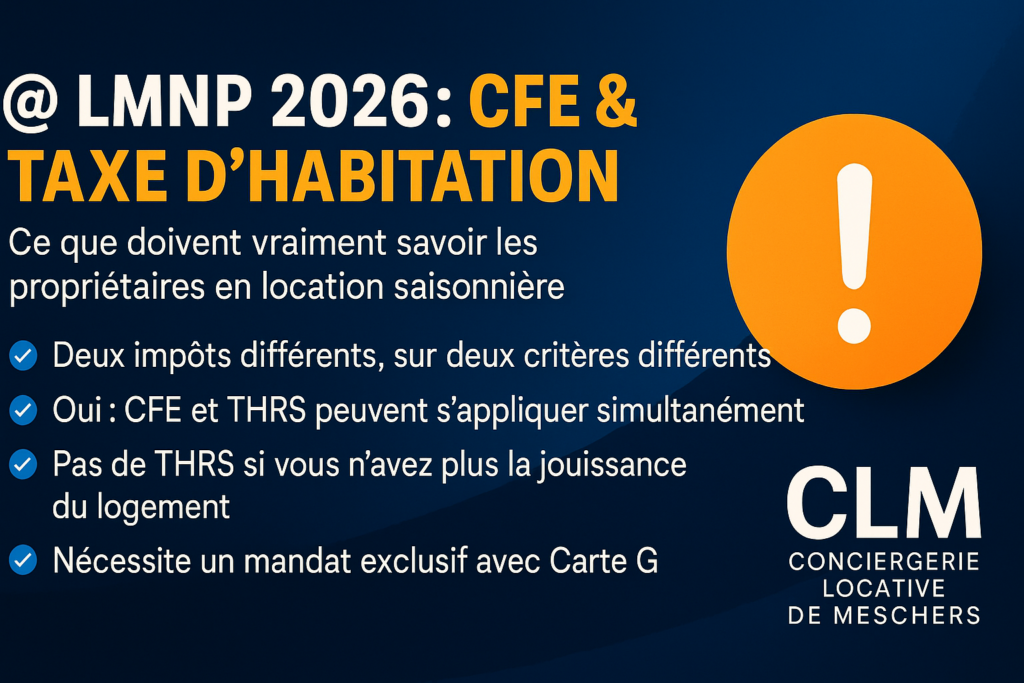
LMNP 2026: CFE & Council Tax (THRS)

What holiday rental owners really need to know

With recent tax changes, many homeowners are wondering whether they should pay :

  • the CFE (Cotisation Foncière des Entreprises),
  • the Council tax on second homes (THRS),
  • or sometimes both.

Online discussions often add to the confusion. So here is a clear, up-to-date version, based on the ministerial responses of 3 June 2025 and current tax doctrine.


1️⃣ CFE and THRS: two different taxes for two different purposes

✔ CFE

The CFE concerns furnished lettings.
It is payable by anyone operating a furnished property, including those operating a LMNP scheme.

There are, however, some possible exemptions:

  • rental income < 5,000 per year,
  • 1st year in business,
  • exemptions decided by the municipality,
  • specific zones (FRR).

✔ THRS (Council tax on second homes)

THRS applies if the owner retains the right of use on 1 January.

That's the crux of the matter:
👉 It's not the number of days rented that counts,
👉 But the possibility of using the accommodation, even rarely.

If you are free to dispose of it, even theoretically, THRS is due.


2️⃣ Yes: CFE and THRS can be applied simultaneously

This is even the situation the most common as a seasonal LMNP.

The two taxes are not linked:

  • CFE taxes the activity,
  • THRS taxes the use of the property.

3️⃣ Can I avoid paying council tax (THRS)?

Yes, in just one case:
👉 if the owner does not retain the use of the property at all.

And this can only be the case :

✔ If the dwelling is entrusted in EXCLUSIVE MANAGEMENT MANDATE

to a professional holder of the G (Hoguet law).

This is the only situation recognised by the tax authorities in which :

  • the owner can no longer use the property,
  • personal use is contractually impossible,
  • enjoyment is transferred to the property manager.

👉 So :

Without a G card = inability to sign an exclusive mandate = the THRS remains due.


4️⃣ What you can't get from a concierge service without a G Card

A concierge service like CLM :

  • does not manage rents,
  • does not draw up a lease,
  • cannot be a rental agent,
  • does not have the legal personality to withdraw use from the owner.

This means that :

❌ It cannot not make you eligible for exemption from THRS.

✔ On the other hand, it can help you understand your LMNP obligations.

This is essential to avoid any ambiguity for owners.


5️⃣ Common mistakes on the internet (and corrections)

❌ “If I rent for 120 days or more, I no longer have to pay council tax.”

➡️ False.
The 120 days concern the registration number, not THRS.


❌ “You have to rent 365 days to avoid THRS.”

➡️ False.
It's not the activity that counts,
but the impossibility of personal use.


❌ “A concierge service can act as an exclusive agent.”

➡️ False if she does not have a G card.
(This is the case for almost all concierge services in France).


6️⃣ What CLM can actually do (and what the law forbids)

CLM can :

  • explain the THRS / CFE rules to you,
  • help you understand your LMNP obligations,
  • help you organise your rental property,
  • managing the operation and quality of housing,
  • optimise your income,
  • help you with your administrative formalities non-financial,
  • advise you objectively on your options.

CLM cannot :

  • manage your rent,
  • sign a rental management agreement,
  • withdraw use of the property,
  • make you eligible for THRS exemption.

This is a legal requirement under the Hoguet Act.


7️⃣ Clear summary: who pays for what?

SituationCFETHRS
Owner retains use of the property✔ Yes✔ Yes
Owner waives use (exclusive mandate Carte G)✔ Yes❌ No
Income < €5,000/year❌ No✔ Yes if used
Rental of part of the principal residence❌ No❌ No
Concierge service without a G card✔ Possible management✔ THRS due

8️⃣ Conclusion

In most cases for holiday lets:

  • CFE is payable (with possible exemptions),
  • THRS is payable as soon as the owner is able to use the property,
  • only an exclusive mandate entrusted to a professional Carte G can be used to remove this THRS.

CLM can help you understanding your obligations, We'll help you optimise your LMNP tax position and manage your business with peace of mind - while complying strictly with the Hoguet Act.

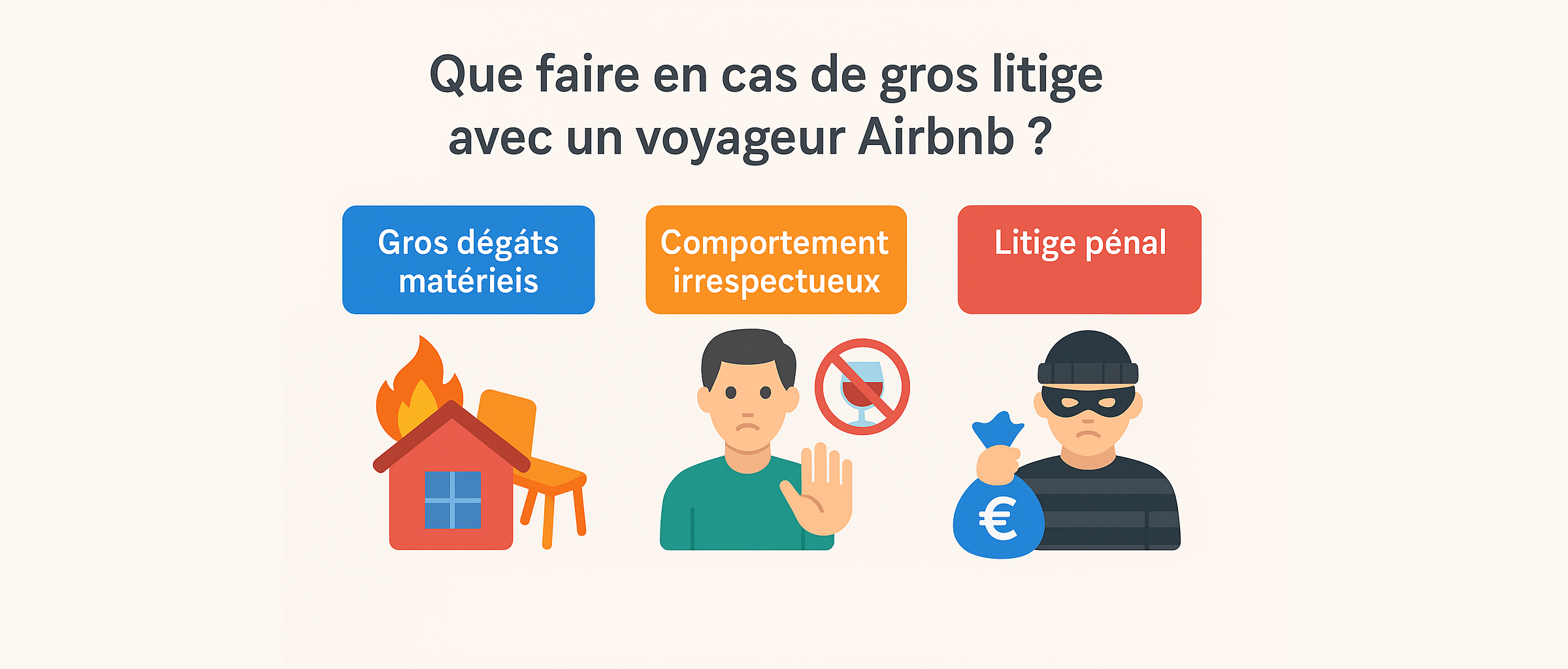
What to do in the event of a major dispute during an Airbnb rental?

Full guide: immediate action, special cases, procedures, and how to prevent it happening again

Over 95 % of Airbnb stays go off without a hitch.
But when a dispute serious damage to property, dangerous behaviour, theft, squatting - it's essential to know what to look out for. what to do immediately, who can help, and how to prevent it from happening again.

This guide offers you a simple, effective and clear method for dealing with every situation.


🧭 Understanding the 4 types of serious disputes.

Airbnb disputes are handled differently depending on their nature.

There are 4 categories:

  1. Major property damage
  2. Dangerous or disrespectful behaviour
  3. Criminal litigation (theft, wilful damage, threats)
  4. Squatter / refusal to vacate

Each category has its own procedure.


1️⃣ CASE 1 - Major property damage

(Destroyed furniture, leak, fire, broken appliances, water damage, etc.)

👉 1. Diagnose in seconds

  • Is the damage visible?
  • Is it the traveller's fault?
  • Or a feature of the property (breakdown, obsolescence)?

👉 2. Secure immediately

  • turn off the water in the event of a leak
  • turn off the electricity if there is a risk
  • isolate the damaged area
  • ventilate in case of smoke

The goal: prevent the damage from getting worse.

👉 3. Document like a professional

Airbnb does not compensate never without evidence.

Take :

  • clear, dated photos
  • videos showing the context
  • before/after if available
  • list of affected objects

👉 4. Declaring actual cause

✔ If the traveller is responsible

  • open an Airbnb folder (AirCover) within 72 hours
  • provide all evidence immediately
  • if booking direct: contact the traveller's home insurance (holiday cover)

✔ If the accommodation is involved (dilapidated condition)

  • declaration to the PNO (homeowner's insurance)
  • it covers the leak, faulty installation, etc.

👉 5. Which solution should be applied?

  • small breakage → deposit
  • average damage → Airbnb AirCover
  • major damage → homeowner's insurance (PNO)

2️⃣ CASE 2 - Dangerous or disrespectful behaviour

(Parties, nuisance, light squatting, failure to comply with rules, etc.)

👉 1. Quickly assess the situation

  • Does the traveller cooperate?
  • Is there any immediate danger?
  • Are neighbours affected?

👉 2. Contact the traveller

A firm but calm message.
In 50 % of cases, the situation is resolved immediately.

👉 3. intervene if necessary

Physical presence (or that of your concierge):

  • soothes
  • shows that
  • avoids escalation

👉 4. Contacting Airbnb: what they manage well

When it comes to problematic behaviour, Airbnb is more efficient than material damage.

Airbnb can :

  • call the passenger directly
  • cancel the rest of your stay
  • ask the traveller to leave
  • block your account if necessary
  • authorise additional cleaning costs
  • cover minor party-related damage

Airbnb is often on the host side, if you have :

  • evidence
  • messages
  • clear house rules
  • complaints from neighbours

👉 5. Proving nuisance

  • sound videos
  • photos
  • messages from neighbours
  • exchanges with the traveller

👉 6. Use the deposit

For :

  • exceptional cleaning
  • damaged linen
  • broken furniture

3️⃣ CASE 3 - Criminal litigation

(Theft, wilful damage, threats, breaking and entering)

These cases are rare but must be treated immediately.

👉 1. Making your home more secure

  • change the key box code
  • close all exits
  • shut down sensitive systems
  • prevent access

👉 2. Taking evidence

Like a mini “statement”:

  • detailed photos
  • videos
  • before/after inventory
  • purchase invoices if available
  • testimonials from neighbours

👉 3. Declare to Airbnb

These files are sent to the Trust & Safety, specialising in serious cases.

👉 4. Making a complaint

It's essential.
Even for a small stolen item, the complaint :

  • lends credibility to the case
  • sometimes allows Airbnb to be reimbursed
  • is required for voluntary cases

🔥 Special cases (the most sensitive)

🟥 1. Theft without breaking and entering

(the traveller had normal access and takes an object with him)

❗ What you need to know

No insurance covers this case.
But you are not without recourse.

✔ Exact procedure:

1. Essential evidence

  • before/after inventory
  • photos
  • proof that no one else entered

2. Filing a complaint
This is essential if Airbnb is to take the case seriously.

3. Wording to be sent to Airbnb :

“The traveller had exclusive access to the accommodation. The object present on arrival disappeared on departure. No other person had access to the accommodation. Complaint lodged - PV attached.”

4. Deposit
For small items (linen, crockery).

✔ Realistic result

  • Small thefts → deposit
  • Clear“ objects → AirCover sometimes
  • Major theft → police + Airbnb (rare)

🟥 2. Deliberate damage

(Deliberate hole, tag, piece of furniture broken on purpose)

❗ What you need to know

Intentional acts are rarely insured.
But Airbnb can refund if the file is solid.

✔ Procedure:

1. Document as a statement of fact

  • close-ups
  • videos
  • precise descriptions

2. Mandatory complaint

3. Airbnb wording :

“The damage is clearly intentional - complaint lodged. Evidence attached. Claim for compensation for wilful damage.”

4. Deposit
Useful as a supplement.

5. For major damage → PNO
For structural damage.


4️⃣ CASE 4 - Squatter / refusal to vacate the premises

(The stay is over, but the traveller remains)

This is the most stressful situation, but it has a clear procedure.

👉 1. DO NOT make a legal error

Do not :

  • forced entry
  • put your stuff outside
  • turn off water/electricity
  • change the lock while the traveller is inside

➡ Legal risk for the owner.

👉 2. Tracking everything on Airbnb

  • remind you of the official end time
  • signal that the traveller remains
  • refuse any “cash off platform” proposal”

Airbnb messages = legal evidence.

👉 3. Report to Airbnb immediately

Airbnb can :

  • call the traveller
  • cancel the holiday
  • request immediate departure
  • block your account
  • guide you legally

👉 4. in France: “occupation without right or title”.”

If the traveller really refuses to leave :

1. Report (photos / video)
2. Filing a complaint for illegal occupation
3. Contact ADIL / lawyer
4. Legal procedure if necessary

These are very rare cases, but they are regulated by law.

👉 5. Role of the concierge

  • Airbnb contact management
  • evidence gathering
  • on-site intervention
  • legal support (guidance)
  • securing the premises as soon as they are vacated

5️⃣ How can these situations be prevented from recurring?

(Prevention = 90 % of tranquillity)

✔ Check traveller profiles

✔ Demand clear rules

✔ Communicating before the trip

✔ Have a complete inventory

✔ Manage entries and exits

✔ Check the accommodation after each stay

✔ Regularly maintain the home


6️⃣ How a concierge service really helps

A serious concierge service to help you:

Before

  • passenger screening
  • inventory
  • rules
  • communication

For

  • rapid intervention
  • Airbnb management
  • documentation
  • mediation
  • securing

After

  • insurance follow-up
  • assistance with filing a complaint
  • repairs
  • prevention for future holidays

🎯 Conclusion

Even the most serious disputes can be managed effectively if the right steps are taken:
secure, document, declare, choose the right procedure, and prevent for the future.

With serious management, the vast majority of these situations can be avoided.

Seasonal lettings: what insurance do you really need to be well covered?

(PNO, traveller's insurance, Airbnb AirCover, deposit... simply explained)

Renting accommodation on a seasonal basis or on Airbnb very quickly raises an essential question:

👉 “If a passenger damages something, who pays? And what does insurance really cover?”

Between the PNO, the traveller's home insurance, AirCover, Booking or the deposit, it's hard to find your way around.


1️⃣ Homeowner's insurance: PNO (Propriétaire Non Occupant)

It is the most important insurance for owners of holiday lets.
It covers the home when it is rented, vacant or occupied by someone else.

✔️ What a PNO covers

  • water damage
  • fire, explosion
  • defects in the property (old appliances, faulty electrical installation, etc.)
  • damage to neighbours
  • burglary (⚠️ not theft by tenant)
  • outdoor vandalism
  • owner's civil liability

❌ What the PNO does not cover

  • theft committed by the traveller
  • deliberate damage
  • linen, crockery, decoration
  • a little everyday breakage (see deposit)
  • damage caused by the tenant (covered by their insurance)

👉 This is the insurance that protects the dwelling itself.


2️⃣ Traveller's insurance: “holiday” insurance”

Most home insurance policies also cover holidays.
This is known as holiday guarantee.

It covers accidental damage caused by the traveller.

✔️ What travel insurance covers

  • fire started by mistake
  • water damage caused by mishandling
  • furniture broken by accident
  • unintentional staining or damage
  • damage caused to neighbours (e.g. leakage to the flat below)

❌ What the holiday does not cover

  • theft committed by the traveller
  • deliberate damage
  • normal wear and tear or defects in the dwelling
  • leaks from old appliances
  • electrical installation problem

👉 It is the insurance that covers the traveller's liability, not the accommodation.

🔍 IMPORTANT :

The resort works whatever the channel (Airbnb, direct, Booking...),
but certificates can only be requested for direct bookings.


3️⃣ Airbnb AirCover: useful, but clearly limited

Airbnb highlights AirCover, presented as protection “up to 3 million”.

But be careful:
➡️ This is not insurance.
➡️ Airbnb can accept... or refuse according to its own rules.
➡️ No legal recourse.

✔️ AirCover works well for :

  • damaged bedding
  • small broken items
  • very dirty cleaning
  • obvious damage

❌ AirCover works very poorly for :

  • theft by the traveller
  • major damage
  • structural damage (leaks, electricity, obsolescence)
  • unbilled items
  • deliberate damage
  • “normal wear and tear” (a word much used to refuse)

👉 AirCover = a little extra, not at all a reliable insurance system.


4️⃣ Booking: no insurance included

Booking does not provide no cover for homeowners.

If there is a problem, management is based on :

  • the PNO
  • the deposit
  • discussion with the traveller

5️⃣ The deposit: essential for minor breakages

The deposit is the practical addition insurance.
It covers :

✔️ Minor breakage or loss

  • tableware
  • glasses
  • missing linen
  • small decorative element
  • abnormally dirty household

❌ The deposit never covers

  • extensive damage
  • major losses
  • major theft
  • housing damage
  • fire / water damage

👉 It is only used for immediate costs, uninsurable.


6️⃣ Clear table: who covers what?

SituationTravel insuranceOwner's PNOAirbnb AirCoverDeposit
Furniture broken by accident✔️⚠️ possible✔️
Very dirty cleaning✔️
Missing linen / broken crockery✔️
Leak linked to an old appliance✔️
Fire caused by the passenger✔️✔️ supplement⚠️
Appliances damaged by obsolescence✔️
Theft by the traveller❌ (excluding break-ins)⚠️ very rare
Deliberate damage⚠️ rare

7️⃣ What about CLM's RC Pro?

CLM's professional liability policy does not cover the traveller's actions, but it does cover professional errors :

✔️ Covered by CLM

  • door not properly closed by an agent
  • window left open
  • key box code not changed
  • lost keys
  • failure to comply with entry/exit protocol

❌ Not covered

  • theft or breakage by the traveller
  • damage caused by the traveller
  • home-related claims

👉 CLM protects against its own mistakes, never the traveller's.


8️⃣ The best protection package for homeowners

To be truly covered, you need to combine :

✔ Home insurance (PNO solid)

✔ Traveller's insurance (operated directly)

✔ Suitable deposit

✔ AirCover in addition (Airbnb only)

✔ Rigorous checks after each stay

✔ Concierge services covered by professional liability insurance

✔ A precise inventory + photos

That's what CLM is doing to make homeowners feel more secure.


🎯 To sum up

Even if no system covers everything, the combination of PNO + traveller's insurance + deposit + AirCover (for Airbnb) + CLM check covers almost all risks seasonal rental.

And for the rest (deliberate theft, bad faith, risky behaviour),
CLM screens, secures and supervises travellers to minimise disputes.

ElementWhat's it for?Reliability?Actual coverage
PNODamage to dwelling, landlord's liability⭐⭐⭐⭐⭐Indispensable
Tenant / holiday insuranceDamage caused by the tenant⭐⭐⭐⭐Very useful
AirCoverAirbnb's way of reassuring⭐⭐✩✩✩Partial coverage, non-contractual
DepositMinor damage, cleaning, laundry⭐⭐⭐Practical complement

Côte de Beauté tourist tax (2025): how does it work and what do you have to declare?

The simple, clear guide for LMNP owners in Meschers, Royan and the surrounding area

If you rent furnished accommodation on the Côte de Beauté, you are affected by the tourist tax.
This may seem a complex subject, but once you know the rules applied by the Royan Atlantique Conurbation Community (CARA), everything becomes simple.

This guide explains :

  • who must declare,
  • how much to pay,
  • how to declare,
  • how to reduce tourist tax,
  • and how CLM can help you.

1️⃣ Who has to pay tourist tax?

The tourist tax is paid by travellers, but it's the host (i.e. you, the owner) who must :

  • collect it,
  • declare it,
  • and pay it back.

Exception: if you use a platform that takes care of this automatically (see below).

The tourist tax covers all furnished rentals :
studio, flat, house, classified or unclassified accommodation.


2️⃣ Airbnb, Booking, Abritel: the simplest case → everything is automatic

If your accommodation is booked via an approved platform, you do not have to nothing to declare.

The platforms :

  • automatically calculate the tax,
  • add it to the price of the stay,
  • collect it from travellers,
  • and pay it directly to CARA.

👉 You don't need to take any action yourself.


3️⃣ “Direct” lettings: you have to declare every month

If your bookings go through :

  • by a personal website,
  • by telephone,
  • through social networks,
  • or by word of mouth...

... then the declaration is not automatic.

It must be done on the official portal of the Agglomération :

👉 https://royanatlantique.taxesejour.fr

You can :

  • register your home,
  • declare your overnight stays,
  • pay the tax,
  • view your due dates.

Deadlines :

  • declaration each month,
  • even if you haven't had no stay (“0 night” declaration).

CLM can help you use this portal, while strictly complying with the Hoguet Act (we never handle your money).


4️⃣ How much will tourist tax cost in 2025?

CARA uses two types of tariffs:


🔹 A) Housing listed (1 to 5 stars) → Fixed rate

Per night and per person :

RankingTariff 2025
⭐⭐⭐⭐⭐1,65 €
⭐⭐⭐⭐1,45 €
⭐⭐⭐1,25 €
⭐⭐1,05 €
0,85 €

✔️ Simple, stable pricing
✔️ Does not vary according to the price of the night
✔️ Often the most advantageous as soon as you rent at a medium or high rate


🔹 B) Housing not classified → Proportional tariff

👉 5 % of the nightly rate, excluding VAT, per person,
capped at 4,14 €,
then increased by +10 % departmental tax
= 4.55 maximum per person / night

Example:

100 € per night → 4,55 € per person
→ €9.10 for a couple
→ €63.70 for 7 nights


5️⃣ How can I reduce tourist tax?

👉 By having your accommodation classified as a “Meublé de Tourisme” (furnished tourist accommodation)”
(1 to 5 stars)

Classification is optional, but it offers two major advantages :
lower tax + a better LMNP regime.


⭐ Advantage 1: a significantly lower tourist tax.

Example for 2 people - 7 nights - €100 per night :

❌ Uncategorized

63.70 tourist tax

✔️ Rated 3★

17,50 €

🎉 Savings: €46.20 per week
Often 300 to 600 € per season,
and up to 1,000 / year for a highly rented property.


⭐ Advantage 2: a better LMNP tax allowance

Micro-BIC :

  • ✔️ 71 % allowance for classified accommodation
  • 50 % or 30 % (depending on the case) for non-classified accommodation

Example:

For annual income of €12,000 :

  • Not classified → taxable = €6,000
  • Classified → taxable = €3,480

🎉 A very significant tax reduction.


🎯 Bonus: a lower tax increases your revenue (even if it is paid by the traveller)

The platforms are still posting final price, including tax.
It is this final price that travellers compare.

👉 High tax = higher final price → less competitive housing
👉 Low tax = lower final price → more attractive home

A classified dwelling therefore benefits from :

  • a lower total price,
  • better positioning in Airbnb/Booking results,
  • a higher booking rate,
  • greater visibility,
  • and ultimately... more income, without increasing your rates.

🎉 It's an invisible optimisation for you, but a very visible one for travellers.


📌 Find out more about the classification (tax benefits + tangible gains)
👉 https://clm-conciergerie.fr/le-bon-plan-lmnp-2026-pourquoi-faire-classer-votre-logement-augmente-fortement-vos-revenus-nets-special-cote-de-beaute/


6️⃣ What CLM can do for you

CLM - Conciergerie Locative de Meschers can :

  • simply explain how the tax works,
  • help you set up your account on the official portal,
  • guide you through the monthly declaration,
  • prepare the necessary information (overnight stays, calendars),
  • advise you on the benefits of obtaining a Meublé de Tourisme classification,
  • help you with your LMNP requirements.

The whole without handling payments, in accordance with the Hoguet Act.


✔️ Conclusion

On the Côte de Beauté, tourist tax is easy to apply as soon as you know :

  • the difference between a platform and direct rental,
  • the tariff applicable to your home,
  • the very strong impact of the ranking,
  • and reporting obligations.

With CLM, You'll be able to rent out your property in a stress-free, compliant way, with optimised net income.

Which platform(s) should you choose to rent your property in 2026?

Understanding services, travellers, costs...

And how a concierge service optimises everything for you

Putting a property up for seasonal letting quickly raises an essential question:

«Which booking channels should I use to maximise my revenue, attract the right travellers and keep management simple?»

Between Airbnb, Booking, Abritel and direct bookings, each platform has its strengths, limitations and different costs.
A concierge service, on the other hand, makes it possible to get the best out of them without complexity.

This article proposes a full comparison, based on :

  • the services actually offered,
  • the type of customers attracted,
  • the management of guarantees and disputes,
  • and net costs, In other words, what is actually left in the owner's pocket.

⭐ 1. understand what each platform really offers

Before discussing commissions, it is essential to understand how each platform influences visibility, safety, the type of traveller and the quality of the stay.


🟧 Airbnb - Global visibility + the power of reputation

Benefits

  • Very large international audience
  • Extremely powerful notification system → boosts the credibility of the accommodation
  • Identity checks for travellers
  • Secure payment
  • Intuitive messaging
  • Centralised litigation process

Limits

  • Non-pre-authorised deposit (virtual deposit)
  • Significant real commission (~16 % in practice)
  • Strong competition between similar goods
  • Downward pressure on prices in certain areas

👉 Relevant for developing the visibility and building the reputation of the accommodation.


🟥 Booking.com - Volume and international travellers

Benefits

  • A large number of quick bookings
  • The most powerful platform for global visibility
  • Large international customer base
  • No costs on the passenger side → very high conversion rate

Limits

  • Highest commission (~17 %)
  • A platform historically designed for the hotel industry
  • No identity check
  • No-show risk if the reservation is not prepaid:
    • Invalid bank card
    • Traveller who doesn't come
    • Lost night

👉 Efficient for filling up quickly, especially in season or for premium goods.


🟦 Abritel / Vrbo - The natural choice for families and long stays

Benefits

  • Reliable family customers
  • Longer stays (1 to 3 weeks)
  • Guarantee actually pre-authorised
  • Fewer disputes
  • Moderate commission (~15 % at real cost)
  • Annual subscription available for large volumes

Limits

  • Less volume than Airbnb and Booking
  • Subscription sometimes misunderstood or underused

👉 Ideal for houses, villas and stays of a week or more.


🟩 Direct booking (CLM site) - Optimised margins + more committed passengers

Benefits

  • Very low commission (~2 % via Stripe Connect)
  • No passenger charges
  • Secure payment
  • Booking page without competition
  • Building loyalty :
    • QR-code in the home
    • Automatic email after your stay
  • Direct and transparent relations
  • Better control of sureties and conditions

Limits

  • Less visibility than the major platforms
  • Initial (quick) configuration of the payment account

👉 The most profitable channel as soon as the traveller discovers you or returns.


⭐ 2. Visitor's tax: what changes depending on the channel

✔ Airbnb, Booking and Abritel

  • Collect automatically tourist tax
  • Pay it directly to the local authority
    → The owner has nothing to do

✔ Direct booking

To simplify this step, a concierge service can provide :

  • exact number of adults
  • number of children
  • number of nights
  • precise amounts to be declared

👉 The process is simple, but not automated.


⭐ 3. Comparison of actual costs (including concierge services)

The most concrete criterion for an owner is often :
«How much do I really have left after expenses?»

Here are the real costs, including :

  • the platform committee,
  • payment charges,
  • 20 % Management (cleaning, laundry, support, maintenance, communication, etc.).

📌 Example for €1,000 paid by the traveller:

ChannelPlatform commission / paymentManagement (20 %)Total expensesNet owner's equity
🟩 Direct website2 %20 %22 %780 €
🟦 Abritel / Vrbo15 %20 %35 %650 €
🟧 Airbnb16 %20 %36 %640 €
🟥 Booking17 %20 %37 %630 €

✔ What this painting highlights

  • La direct booking maximises net income.
  • Abritel offers a very good volume/quality/profitability trade-off.
  • Airbnb and Booking provide a high level of visibility, but on the highest cost.
  • A single overnight stay can earn up to €150 difference depending on the channel used.

⭐ 4. Final ranking - from most cost-effective to most expensive

RankPlatformNet incomeSpecial features
🟩 1Direct website780 €Most profitable channel
🟦 2Abritel650 €Excellent for long stays
🟧 3Airbnb640 €Excellent visibility + reviews
🟥 4Booking630 €Highest commission

⭐ 5. The winning strategy in 2026: don't choose... but combine intelligently

No platform is perfect.
Each attracts a different type of traveller at a different time.

The really effective strategy :

Airbnb & Booking → Visibility + volume

  • Fast fill rate
  • Excellent public credibility

Abritel → Families + long stays

  • Greater stability
  • Fewer disputes
  • Higher revenue per stay

Direct website → Maximum profitability

  • No intermediaries
  • A lasting relationship with travellers
  • Maximised net income

✔ A multi-channel concierge service to orchestrate it all

  • Calendar synchronisation
  • Smart pricing based on season / demand
  • Centralised message management
  • Optimising visibility
  • 7/7 Travellers Helpdesk
  • On-site service management
  • Help with declaring tourist tax
  • Clear and transparent reporting

⭐ Conclusion: your property deserves a strategy, not a default choice

Choosing a platform is not just a question of commission:
is a balance between visibility, quality of the traveller, security, easy to manage, and net income.

The best approach in 2026 is to :

✔ understand what each channel really contributes
✔ choose a combination suited to your home
✔ let a concierge optimise the whole thing
✔ monitor transparent and measurable results
✔ maximise profitability over the long term

Visibility + service + profitability = an effective multi-channel strategy.
A simple, intelligent and sustainable choice for your benefit.

The 2026 LMNP plan: why having your property classified will significantly increase your net income

You rent your property to Meschers, Royan, Saint-Georges-de-Didonne, Vaux-sur-Mer, Talmont… ?
You are LMNP (or are you about to become one)?
And you're looking for leverage simple, legal and cost-effective to pay less tourist tax and less tax ?

🎉 Good news: Meublé de Tourisme classification (1 to 5 stars) is one of best LMNP levers in 2026, particularly in the Royan Atlantique Conurbation Community (CARA).

Here's why.👇


📌 1. Rankings: what are they?

Le Furnished Tourist Accommodation classification is an official certification issued by an accredited body (Atout France).

It awards 1 to 5 stars, based on a grid of more than 130 criteria:

  • equipment,
  • comfort,
  • developments,
  • services,
  • environment,
  • safety...

The classification is recognised:

  • by Airbnb / Booking,
  • by the town hall,
  • by the CARA,
  • by the tax,
  • and appears on the Official Cerfa declaration at the town hall.

💥 2. Classification lowers tourist tax (a lot)

In the Communauté d'Agglomération Royan Atlantique, the 2025-2026 fares are very clear.

A) CLASSIFIED accommodation: fixed rate per person per night

RankingRate (CARA + departmental tax)
⭐⭐⭐⭐⭐1,65 €
⭐⭐⭐⭐1,45 €
⭐⭐⭐1,25 €
⭐⭐1,05 €
0,85 €

➡️ Price list does not depend on the price of the night, Only the number of passengers.


❌ B) UNCLASSIFIED accommodation: proportional rate

👉 5 % of the price per night per person, excluding VAT, capped at €4.14
→ +10 % departmental tax = 4.55 max / person

🎯 The more expensive the night, the higher the tax.


📊 3. CHIFRATED comparison: classified vs unclassified

(Official CARA example - based on €100 / night for 2 people)

❌ UNCLASSIFIED

5 % × €100 = €5 → capped at €4.14
+10 % = 4.55 € / person / night
→ €9.10 / night for 2 people
63.70 € / week

✔ CLASSED (3★)

1.25 € / person / night
→ €2.50 / night for 2 people
17.50 € / week

🎉 Net savings : 46.20 € / week

300 to 600 € / season
1 000 € and more / year for a well-let property

If you are hosting 4 people :
➡️ savings double.


💸 Bonus: lower tourist tax = more bookings

Travellers watch the total price displayed, including tax.

Example for a couple:

  • Uncategorized : 109.10 € / night
  • Classified : 102.50 / night

➡️ Without touching your own price, you become more attractive.

Result:

  • better positioning in Airbnb searches,
  • more clicks,
  • more bookings,
  • higher net income.

💰 4. Ranking also improves your LMNP tax income

Since 2026 :

Type of accommodationMicro-BIC allowance
Uncategorized30 %
Classified as furnished tourist accommodation50 %
(71 % = deleted)**

🎯 The ranking no longer 71 %, but it remains significantly more advantageous than 30 %.

Example: €12,000 annual income

UncategorizedRated
Allowance30 %50 %
Tax base8 400 €6 000 €
Taxable difference2,400 in untaxed income

➡️ Even without the 71 %, the ranking significantly reduces the tax base.


📈 5. Ranking also improves your online visibility

The platforms enhance :

  • housing certified,
  • ads with increased confidence,
  • the criteria for quality checked.

A classified dwelling :

  • appears in the search filters,
  • inspires confidence,
  • converts better,
  • attracts more families and tourists from abroad,
  • increases occupancy rates 10 to 20 %.

🪙 6. The cost of classification is low... and immediately amortised

Average rates for Atout France-approved organisations :

  • Flat : 120 à 180 €
  • House : 180 à 250 €

Validity : 5 years

Amortisation via :

  • reduced tourist tax,
  • more advantageous tax treatment,
  • best performance on Airbnb / Booking.

👉 In most cases, ranking is profitable in 1 to 2 weeks' rental.


🧭 7. How do you classify your accommodation on the Côte de Beauté?

✔ Find an approved body

https://www.classement.atout-france.fr

✔ Preparing your home

CLM can help you :

  • check for missing criteria,
  • easily optimise your score,
  • aim for 3★ or 4★, the best effort/gain ratio.

✔ Have the visit carried out

The inspector checks the criteria → award → official publication.

✔ Update your ad

CLM takes care of everything on :

  • Airbnb
  • Booking
  • Abritel
  • Tourist tax portal
  • Cerfa town hall

🏆 8. Why does CLM strongly recommend ranking in 2026?

Because today is the day one of the best returns on investment in the LMNP sector.

AdvantageReal impact
Tourist tax divided by 2 to 4+300 to €1,500/year
Taxation (allowance 50 %)+1,000 to +3,000 €/year
Better visibility on Airbnb+10 to +20 % reservations
Low costAmortized in 1 to 2 weeks
Duration 5 yearsExceptional ROI

📊 Summary table - unclassified vs classified accommodation (basis €1,000)

ElementsUncategorizedRated
Price paid by the passenger1 000 €1 000 €
Platform Committee-150 €-150 €
Income after platform850 €850 €
Concierge service (20 % inc. VAT)-170 €-170 €
Income before tax680 €680 €
Micro-BIC tax allowance30 %50 %
Tax base476 €340 €
Taxes (30 %)-143 €-102 €
NET final proprietary537 €578 €
Net profitability53,7 %57,8 %

💬 Conclusion

🎉 The ranking is THE 2026 LMNP plan for property owners on the Côte de Beauté.

It is :

  • simple,
  • officially recognised,
  • tax benefits,
  • very profitable,
  • validated by the CARA, the Town Hall and the State.

And above all :

👉 It simultaneously increases
your attractiveness + your occupancy rate + your net income.


📞 Ready to classify your home?

CLM - Conciergerie Locative de Meschers can help you :

  • advice
  • preparation
  • optimisation
  • steps
  • ad updates
  • LMNP optimisation

Contact us for a free estimate of your potential earnings.