
Full guide: immediate action, special cases, procedures, and how to prevent it happening again
Over 95 % of Airbnb stays go off without a hitch.
But when a dispute serious damage to property, dangerous behaviour, theft, squatting - it's essential to know what to look out for. what to do immediately, who can help, and how to prevent it from happening again.
This guide offers you a simple, effective and clear method for dealing with every situation.
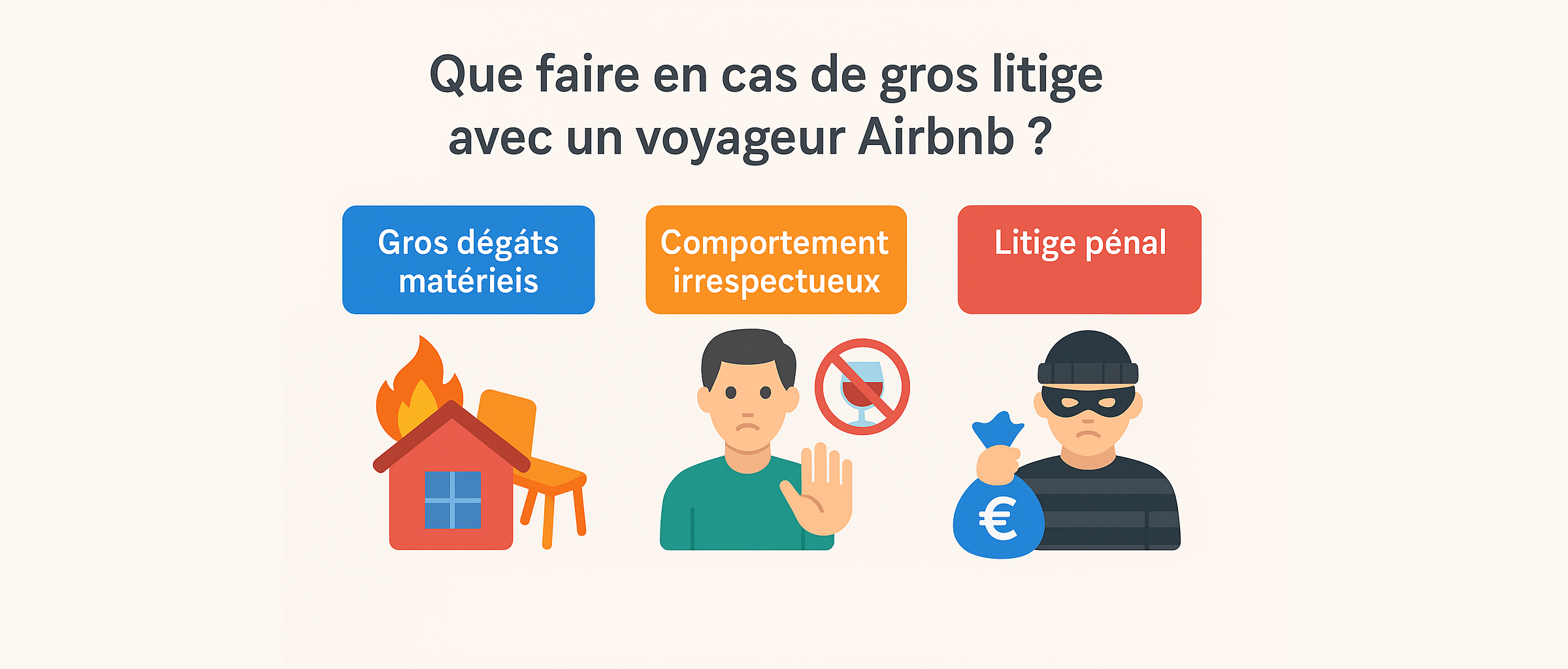
🧭 Understanding the 4 types of serious disputes.
Airbnb disputes are handled differently depending on their nature.
There are 4 categories:
- Major property damage
- Dangerous or disrespectful behaviour
- Criminal litigation (theft, wilful damage, threats)
- Squatter / refusal to vacate
Each category has its own procedure.
1️⃣ CASE 1 - Major property damage
(Destroyed furniture, leak, fire, broken appliances, water damage, etc.)
👉 1. Diagnose in seconds
- Is the damage visible?
- Is it the traveller's fault?
- Or a feature of the property (breakdown, obsolescence)?
👉 2. Secure immediately
- turn off the water in the event of a leak
- turn off the electricity if there is a risk
- isolate the damaged area
- ventilate in case of smoke
The goal: prevent the damage from getting worse.
👉 3. Document like a professional
Airbnb does not compensate never without evidence.
Take :
- clear, dated photos
- videos showing the context
- before/after if available
- list of affected objects
👉 4. Declaring actual cause
✔ If the traveller is responsible
- open an Airbnb folder (AirCover) within 72 hours
- provide all evidence immediately
- if booking direct: contact the traveller's home insurance (holiday cover)
✔ If the accommodation is involved (dilapidated condition)
- declaration to the PNO (homeowner's insurance)
- it covers the leak, faulty installation, etc.
👉 5. Which solution should be applied?
- small breakage → deposit
- average damage → Airbnb AirCover
- major damage → homeowner's insurance (PNO)
2️⃣ CASE 2 - Dangerous or disrespectful behaviour
(Parties, nuisance, light squatting, failure to comply with rules, etc.)
👉 1. Quickly assess the situation
- Does the traveller cooperate?
- Is there any immediate danger?
- Are neighbours affected?
👉 2. Contact the traveller
A firm but calm message.
In 50 % of cases, the situation is resolved immediately.
👉 3. intervene if necessary
Physical presence (or that of your concierge):
- soothes
- shows that
- avoids escalation
👉 4. Contacting Airbnb: what they manage well
When it comes to problematic behaviour, Airbnb is more efficient than material damage.
Airbnb can :
- call the passenger directly
- cancel the rest of your stay
- ask the traveller to leave
- block your account if necessary
- authorise additional cleaning costs
- cover minor party-related damage
Airbnb is often on the host side, if you have :
- evidence
- messages
- clear house rules
- complaints from neighbours
👉 5. Proving nuisance
- sound videos
- photos
- messages from neighbours
- exchanges with the traveller
👉 6. Use the deposit
For :
- exceptional cleaning
- damaged linen
- broken furniture
3️⃣ CASE 3 - Criminal litigation
(Theft, wilful damage, threats, breaking and entering)
These cases are rare but must be treated immediately.
👉 1. Making your home more secure
- change the key box code
- close all exits
- shut down sensitive systems
- prevent access
👉 2. Taking evidence
Like a mini “statement”:
- detailed photos
- videos
- before/after inventory
- purchase invoices if available
- testimonials from neighbours
👉 3. Declare to Airbnb
These files are sent to the Trust & Safety, specialising in serious cases.
👉 4. Making a complaint
It's essential.
Even for a small stolen item, the complaint :
- lends credibility to the case
- sometimes allows Airbnb to be reimbursed
- is required for voluntary cases
🔥 Special cases (the most sensitive)
🟥 1. Theft without breaking and entering
(the traveller had normal access and takes an object with him)
❗ What you need to know
No insurance covers this case.
But you are not without recourse.
✔ Exact procedure:
1. Essential evidence
- before/after inventory
- photos
- proof that no one else entered
2. Filing a complaint
This is essential if Airbnb is to take the case seriously.
3. Wording to be sent to Airbnb :
“The traveller had exclusive access to the accommodation. The object present on arrival disappeared on departure. No other person had access to the accommodation. Complaint lodged - PV attached.”
4. Deposit
For small items (linen, crockery).
✔ Realistic result
- Small thefts → deposit
- Clear“ objects → AirCover sometimes
- Major theft → police + Airbnb (rare)
🟥 2. Deliberate damage
(Deliberate hole, tag, piece of furniture broken on purpose)
❗ What you need to know
Intentional acts are rarely insured.
But Airbnb can refund if the file is solid.
✔ Procedure:
1. Document as a statement of fact
- close-ups
- videos
- precise descriptions
2. Mandatory complaint
3. Airbnb wording :
“The damage is clearly intentional - complaint lodged. Evidence attached. Claim for compensation for wilful damage.”
4. Deposit
Useful as a supplement.
5. For major damage → PNO
For structural damage.
4️⃣ CASE 4 - Squatter / refusal to vacate the premises
(The stay is over, but the traveller remains)
This is the most stressful situation, but it has a clear procedure.
👉 1. DO NOT make a legal error
Do not :
- forced entry
- put your stuff outside
- turn off water/electricity
- change the lock while the traveller is inside
➡ Legal risk for the owner.
👉 2. Tracking everything on Airbnb
- remind you of the official end time
- signal that the traveller remains
- refuse any “cash off platform” proposal”
Airbnb messages = legal evidence.
👉 3. Report to Airbnb immediately
Airbnb can :
- call the traveller
- cancel the holiday
- request immediate departure
- block your account
- guide you legally
👉 4. in France: “occupation without right or title”.”
If the traveller really refuses to leave :
1. Report (photos / video)
2. Filing a complaint for illegal occupation
3. Contact ADIL / lawyer
4. Legal procedure if necessary
These are very rare cases, but they are regulated by law.
👉 5. Role of the concierge
- Airbnb contact management
- evidence gathering
- on-site intervention
- legal support (guidance)
- securing the premises as soon as they are vacated
5️⃣ How can these situations be prevented from recurring?
(Prevention = 90 % of tranquillity)
✔ Check traveller profiles
✔ Demand clear rules
✔ Communicating before the trip
✔ Have a complete inventory
✔ Manage entries and exits
✔ Check the accommodation after each stay
✔ Regularly maintain the home
6️⃣ How a concierge service really helps
A serious concierge service to help you:
Before
- passenger screening
- inventory
- rules
- communication
For
- rapid intervention
- Airbnb management
- documentation
- mediation
- securing
After
- insurance follow-up
- assistance with filing a complaint
- repairs
- prevention for future holidays
🎯 Conclusion
Even the most serious disputes can be managed effectively if the right steps are taken:
secure, document, declare, choose the right procedure, and prevent for the future.
With serious management, the vast majority of these situations can be avoided.